
Executive Summary
Most enterprise API security programs focus on the moment an API is live: is it authenticated, is it rate-limited, is it monitored. Far fewer programs treat the API lifecycle itself, from the first design decision to the day an endpoint is finally switched off, as a security control. This is a significant gap. Akamai's 2026 State of the Internet security report found that 87% of organizations experienced an API-related security incident in 2025, with attack volume per organization up 113% year-over-year [1]. A meaningful share of that exposure does not come from actively maintained, well-governed APIs. It comes from APIs that were never formally inventoried, versions that were deprecated on paper but never switched off, and endpoints that outlived the business purpose they were built for.
This eBook is a practical governance playbook for treating the full API lifecycle, design, build, deployment, versioning, deprecation, and retirement, as a security discipline. Each chapter covers one stage of the lifecycle, the specific risks that stage introduces, and the governance controls that address them. Later chapters quantify the cost of getting the lifecycle wrong, examine how agentic AI is placing new pressure on deprecation and retirement practices in particular, and apply the lifecycle lens to financial services, healthcare, and technology use cases. The eBook concludes with the CyberTech Intelligence Enterprise API Governance Framework, a practical decision model for retirement, and a roadmap for implementation.
Introduction: Why the API Lifecycle Is a Security Problem
APIs are treated as products in most modern engineering organizations, and that framing has real value: it encourages documentation, versioning discipline, and attention to the developer experience. But product thinking alone does not answer a security question that matters just as much: at any given moment, does the organization know every API it has, who owns each one, what data it touches, and whether it should still exist.
That question is harder to answer than it sounds. Wallarm's 2026 API ThreatStats Report found that 43% of vulnerabilities added to the U.S. Cybersecurity and Infrastructure Security Agency's Known Exploited Vulnerabilities catalog in 2025 were API-related, the single largest category in that dataset [3]. Verizon's 2026 Data Breach Investigations Report found that exploited vulnerabilities are now the leading initial access vector for breaches generally, at 31% of cases [2]. Neither statistic distinguishes between actively maintained APIs and forgotten ones, but the security community's own research increasingly does: industry analysis of zombie and shadow APIs, endpoints that are either undocumented or officially deprecated yet still reachable, consistently identifies lifecycle gaps, not just weak authentication, as the underlying cause.
The 2022 Optus data breach remains one of the clearest public illustrations of this problem. According to filings with the Australian Communications and Media Authority reviewed by SecurityScorecard, the API responsible for the breach became internet-facing in 2020, but its access controls had been rendered ineffective by a coding error introduced as early as 2018, and it required no authentication when it was exploited in September 2022, exposing the personal information of more than 9.5 million customers [11]. The vulnerability was not a novel exploit. It was a lifecycle failure: an API that should have been governed, monitored, or retired sat exposed for years before anyone noticed.
Chapter 1: The API Lifecycle as a Security Problem, Not Just a Product Problem
A useful API lifecycle model has five stages that matter from a security standpoint: design, build and deploy, operate, version and deprecate, and retire. Each stage introduces a distinct category of risk, and each requires a different governance response. Treating the lifecycle as a single undifferentiated “API security” problem tends to concentrate all investment on the operate stage, typically through an API gateway or runtime protection tool, while leaving the design, deprecation, and retirement stages under-governed.
This matters because the data suggests risk is not evenly distributed across the lifecycle. OWASP's API Security Top 10 identifies broken object-level authorization, broken authentication, and unrestricted resource consumption as leading categories, all of which are substantially influenced by decisions made at design time, not runtime [4]. At the other end of the lifecycle, industry research on zombie APIs consistently finds that deprecated endpoints retain their original data access and authentication weaknesses because deprecation was documented but never technically enforced. The lifecycle, in other words, is not a neutral project-management framework layered on top of security. It is where a large share of the actual risk originates and persists.
Google Cloud's Cloud Threat Horizons Report H1 2026 reinforces this from the cloud infrastructure side, finding that identity compromise underpinned 83% of cloud-related compromises analyzed and that third-party software-based entry accounted for 44.5% of observed initial access activity, overtaking weak credentials as the leading vector [10]. APIs are frequently the mechanism through which that third-party and identity-based access actually operates technically, which means API lifecycle governance and cloud identity governance are addressing overlapping, not separate, risk.
Chapter 2: Design and Build — Shifting Security Left
The design stage is where the most consequential and least expensive security decisions get made. An API's authentication model, its data exposure surface, and its authorization logic are all design-time decisions, and OWASP's API Security Top 10 findings on broken object-level and function-level authorization describe failures that are structurally difficult to fix after an API is in production without a breaking change [4].
A design-first approach, defining the API contract using the OpenAPI Specification before implementation begins, gives governance teams a concrete artifact to review rather than relying on documentation written after the fact. Three governance controls belong at this stage. First, every new API should be classified by data sensitivity before its first line of code is written, so that authentication and logging requirements are set by policy rather than by individual developer judgment. Second, authentication and authorization models should be selected from a small, approved set of patterns, OAuth 2.0 with appropriate scopes, mutual TLS, or equivalent, rather than left open to ad hoc implementation. Third, every new API should be assigned a named owner at creation, not after an incident makes ownership suddenly urgent.
Gartner's API protection guidance is significant here because it reflects how central APIs have become to enterprise operations generally, describing APIs as a dominant source of dynamic internet traffic and making API protection a central requirement for security programs [8]. Protection that begins only once an API reaches production is, by that framing, addressing the problem several stages too late.
Chapter 3: Deploy and Operate — Governance in Production
Once an API is live, governance shifts from design review to continuous validation. This is the stage most existing API security tooling addresses, through gateways, runtime protection, and traffic analysis, and it remains necessary. Salt Security's research found that two-thirds of organizations reported API growth exceeding 50% in the past year, meaning the operate stage now covers a rapidly expanding surface even before lifecycle gaps are considered [9].
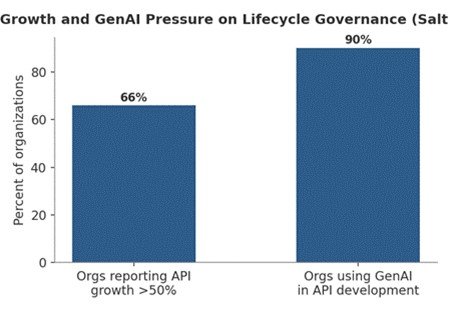 Figure 1. API growth and GenAI adoption pressure on lifecycle governance (Salt Security).
Effective operate-stage governance requires three ongoing practices. Continuous discovery should compare actual production traffic against the organization's documented API inventory on an ongoing basis, since the gap between the two is exactly where shadow APIs, endpoints deployed without going through governance review, tend to appear. Runtime authorization checks should validate that authenticated users can only access data and functions they are explicitly entitled to, directly addressing the broken object-level authorization category that both OWASP's API-specific guidance and its broader Top 10:2025 update continue to flag as a leading risk [4][5]. Ownership and ongoing accountability should be reviewed periodically, not only at creation, since the original owner of an API frequently changes teams, leaves the organization, or moves to a different project well before the API itself is retired.
Chapter 4: Version and Deprecate — The Most Neglected Stage
Versioning and deprecation are where API lifecycle governance most often breaks down in practice, and where the technical standards available to enterprises are, in CyberTech Intelligence's assessment, significantly under-adopted relative to how well-specified they are. The Internet Engineering Task Force has defined two HTTP headers specifically for this purpose. RFC 8594 defines the Sunset header field, which signals that a given API endpoint is likely to become unresponsive at a specified future point in time [6]. A companion specification, the Deprecation HTTP header field, indicates that an endpoint is deprecated and carries a structured timestamp for when that deprecation takes effect, intended to be used alongside the Sunset header rather than in place of it [7].
Despite being open, well-documented standards, these headers are inconsistently implemented across enterprise API estates, which means client applications and downstream consumers frequently have no machine-readable signal that an endpoint is being phased out. The practical consequence is that deprecation becomes a documentation exercise, a note in a developer portal or a changelog entry, rather than a technical control that client tooling can act on automatically.
CyberTech Intelligence recommends four deprecation practices. Every deprecation should set both a Deprecation header with an effective date and a Sunset header with a hard decommission date, giving consuming systems a machine-readable migration deadline rather than only a written notice [6][7]. Every deprecated endpoint should be tracked in the same inventory system used for active APIs, with an explicit “deprecated, pending retirement” status, rather than being removed from tracking once it is no longer the recommended version. Every deprecation should include direct notification to known consumers, identified through API key or token usage logs, not only a general announcement. And every deprecated endpoint should be reviewed on a fixed cadence, for example every 90 days, to confirm whether its traffic has actually declined toward zero or whether it remains in unexpected use, a pattern industry research on zombie APIs consistently associates with endpoints that were deprecated on paper but never enforced technically.
Chapter 5: Retire — Secure Decommissioning
Retirement is the stage most likely to be skipped entirely, and the data suggests it is also one of the more consequential omissions in the lifecycle. An API that has been deprecated but not technically retired, meaning its endpoint still responds to requests, retains whatever authentication weaknesses, data access, and outdated protocol support it had at the point it was deprecated, often without the ongoing monitoring applied to active systems. Security research on this pattern consistently finds that such endpoints, sometimes called zombie APIs, fall outside standard monitoring and alerting because security tooling is generally configured around what is documented as currently active, not what technically still exists.
Secure retirement requires a defined technical process, not only a decision. The endpoint's authentication and authorization mechanisms should be disabled first, converting any residual traffic into failed requests rather than successful ones. Data the endpoint could access should be reviewed for whether it can be deleted, archived, or must be retained under a documented policy, since retirement is also the point at which data minimization obligations under frameworks such as GDPR most directly apply. DNS records, load balancer rules, and any remaining routing configuration should be confirmed removed, not merely disabled, since routing rules quietly left in place are a common way retired endpoints resurface. Finally, the endpoint should return a 410 Gone response rather than a generic 404, since a 410 explicitly signals permanent removal to both automated clients and developers troubleshooting integration failures, reducing the chance that a consuming team assumes the endpoint is only temporarily unavailable.
Chapter 6: The Cost of Getting the Lifecycle Wrong
Lifecycle governance gaps are not only a technical concern; they carry quantifiable financial consequences that show up in breach-cost data even when the underlying research was not designed to measure lifecycle maturity specifically. IBM's Cost of a Data Breach Report 2025 found that breaches involving data spread across multiple environments, public cloud, private cloud, and on-premises together, cost an average of $5.05 million, compared with $4.01 million for breaches confined to on-premises systems [12]. Forgotten and deprecated APIs are disproportionately likely to sit at exactly these environment boundaries, created during a migration, left behind after a platform consolidation, or spun up in a test environment that was never formally decommissioned.
Detection speed compounds the problem specifically for lifecycle-related exposure. IBM's data shows breaches identified after 200 days cost organizations an average of $5.49 million, compared with $3.61 million for breaches contained faster [12]. Zombie and shadow APIs are, almost by definition, the assets least likely to be caught quickly, because they fall outside the monitoring and alerting configured around an organization's documented, actively maintained inventory. An API that nobody knows exists cannot generate an alert when it behaves unusually. The Optus case illustrates this directly: the vulnerable API had been exposed since 2020, following a coding error from 2018, and was only discovered after several days of active exploitation in September 2022, a multi-year detection gap that maps closely onto IBM's most expensive breach category [11][12].
The financial case for lifecycle governance is therefore not only about preventing a specific incident. It is about reducing the number of long-lived, unmonitored assets in the environment that make detection slow when an incident does occur, directly addressing the cost driver IBM's research identifies as the single largest lever on final breach cost.
Chapter 7: AI Agents and the New Lifecycle Pressure
Agentic AI is changing API lifecycle governance in a specific, measurable way: it is dramatically increasing the number of machine identities calling APIs, and it is doing so faster than most lifecycle governance processes were designed to track. Research from the Cloud Security Alliance and multiple identity-security vendors published in 2026 places non-human identities, service accounts, API keys, OAuth tokens, and AI agent credentials, at anywhere from roughly 45 times to over 140 times the number of human identities in a typical enterprise, with cloud-native and DevOps-heavy environments trending toward the higher end of that range [13]. AI agents are consistently identified as the fastest-growing category within that non-human identity population, and a large share are granted standing API access to internal systems, data, and third-party services in order to complete tasks autonomously.
This shift matters for every stage of the lifecycle described in this eBook, not only the operate stage. At design time, an API built for human-initiated requests may not have been built to handle the request volume, authorization patterns, or failure modes of an autonomous agent calling it repeatedly and rapidly. At the deprecation and retirement stages, AI agents that were configured to call a specific endpoint do not necessarily respect a Sunset header the way a human developer reading a deprecation notice would; without machine-readable deprecation signals actually wired into agent tooling, an agent may continue calling a retired or soon-to-be-retired endpoint indefinitely, which is precisely why the technical enforcement described in Chapter 4 matters more, not less, as agentic AI adoption grows.
CyberTech Intelligence recommends that organizations extend the API Governance Framework's ownership and classification requirements explicitly to cover AI agent consumers: every API should have a documented answer for whether it is intended to be called by autonomous agents, what rate and volume of calls that implies, and how the agent's access will be revoked if the underlying API is deprecated or the agent's authorization is later found to be excessive. Treating AI agent access as simply another API consumer, without this explicit review, risks quietly reintroducing exactly the ownership and inventory gaps this eBook argues the lifecycle framework is designed to close.
Industry Applications
Financial services organizations operate under the most prescriptive version of these lifecycle requirements. Open banking and payment-initiation APIs are frequently subject to regulatory requirements for auditable change management, meaning a deprecation or retirement decision is not only a technical action but a compliance event requiring documentation of what changed, when, and why. Financial institutions that have not connected their API inventory to their broader regulatory evidence processes are, in practice, tracking the same lifecycle information twice, once for engineering purposes and once for compliance, with no guarantee the two stay synchronized.
Healthcare organizations face a related but distinct version of the same challenge. Clinical and patient-data APIs frequently persist far longer than their original integration partners intend, as legacy systems are replaced but old interfaces remain active to support a shrinking population of laggard integrations. A deprecated healthcare API that is never technically retired carries not only the general zombie-API risk described in Chapter 5, but a direct regulatory exposure under frameworks that treat any accessible protected health information as a live compliance obligation regardless of whether the API is officially supported.
Technology and SaaS providers experience the lifecycle problem from both directions at once. As API providers, they must govern their own design, deprecation, and retirement processes at a scale that often spans thousands of endpoints across multiple product lines. As consumers of their own third-party dependencies, they must track when the external APIs they integrate with are themselves deprecated, a lifecycle-awareness requirement that is frequently overlooked because it depends on a vendor's external communication rather than internal governance the organization directly controls.
CyberTech Intelligence recommends that enterprises formalize the practices described in the preceding chapters through the CyberTech Intelligence Enterprise API Governance Framework™.
Purpose: to give platform, security, and API product teams a shared operating model that treats every stage of the API lifecycle, not only the runtime stage, as a governed security control.
Scope: applies to internally developed, partner-facing, and third-party-consumed APIs across their full lifecycle, from design through retirement.
|
Lifecycle Stage |
Governance Control |
Evidence Produced |
|
Design |
Data-sensitivity classification and approved authentication pattern assigned before development begins |
Design review record with named owner |
|
Build and Deploy |
OpenAPI specification validated against governance rules before release |
Specification version linked to deployment record |
|
Operate |
Continuous discovery reconciles production traffic against the documented inventory |
Reconciliation report; authorization test results |
|
Version and Deprecate |
Deprecation and Sunset headers applied; consumers notified directly |
Deprecation timeline; consumer notification log |
|
Retire |
Authentication disabled, routing removed, 410 Gone response confirmed |
Decommissioning record; data disposition decision |
Inputs to this framework include the organization's API gateway, OpenAPI specification repository, identity and access management platform, and API traffic telemetry. Outputs include a continuously current API inventory, a lifecycle-stage status for every API the organization operates, and a decommissioning record for every retired endpoint. Ownership sits with platform engineering for the build, deploy, and operate stages, and jointly with platform engineering and security for versioning, deprecation, and retirement decisions, since retirement in particular carries data-disposition and compliance implications that extend beyond a purely technical decision.
Practical Implementation Guidance
Organizations do not need to replace existing API management tooling to adopt this framework. Most enterprises already operate an API gateway and an OpenAPI specification repository; the practical work is connecting those systems to the deprecation and retirement practices described above, which are frequently the least automated part of an otherwise mature API program.
A reasonable starting point is a full inventory reconciliation: comparing every API documented in the specification repository against actual production traffic observed at the gateway over a recent 90-day window. Endpoints appearing in traffic but not in documentation are shadow APIs requiring immediate classification. Endpoints appearing in documentation as deprecated but still receiving traffic are zombie APIs requiring an accelerated retirement decision. This single exercise typically surfaces the majority of an organization's lifecycle governance gaps and provides a concrete, evidence-based starting inventory for the framework above, rather than requiring governance to be designed in the abstract before any real gaps are identified.
Automation matters more at the deprecation and retirement stages than anywhere else in the lifecycle, precisely because these are the stages most often left to manual process today. Most modern API gateways can enforce Deprecation and Sunset headers through configuration rather than requiring code changes in the underlying service, which means the technical barrier to adopting the standards described in Chapter 4 is generally lower than the organizational barrier of deciding who owns that configuration and when it gets applied. Organizations should also instrument alerting on deprecated endpoints specifically: rather than treating silence as success, a deprecated API that continues receiving meaningful traffic as its Sunset date approaches should generate an active alert to its named owner, not simply appear as a line item in a periodic report that may not be reviewed before the retirement decision is due.
Finally, organizations should resist the temptation to treat this as a one-time cleanup project. The inventory reconciliation exercise is most valuable when repeated on a fixed schedule, because new shadow and zombie APIs accumulate continuously as teams ship new integrations, migrate platforms, and stand up temporary endpoints for testing that quietly become permanent. A quarterly reconciliation cadence, aligned with the governance review described in the framework above, keeps the gap between documented and actual API inventory from widening again after the initial cleanup is complete.
Retirement Decision Checklist
Before marking any API as fully retired, the responsible owner should be able to answer the following questions.
- Has the Sunset date passed, and has traffic to the endpoint actually reached zero, not merely declined?
- Have all known consumers, identified through API key or token usage logs, been directly notified and confirmed migrated?
- Has a decision been documented for any data the endpoint could access: deletion, archival, or continued retention under a specific policy?
- Have authentication and authorization mechanisms been disabled, not merely removed from documentation?
- Have DNS records, load balancer rules, and gateway routing configuration been confirmed removed rather than only disabled?
- Does the endpoint now return a 410 Gone response rather than continuing to respond successfully or returning a generic 404?
Roadmap
CyberTech Intelligence recommends a three-phase roadmap for adopting full-lifecycle API governance. In the first phase, typically the first 60 days, organizations should complete the inventory reconciliation exercise described above and classify every discovered gap as a design, operate, or retirement issue. In the second phase, spanning roughly two to four months, organizations should implement Deprecation and Sunset header standards across API gateways, assign named owners to every API in the reconciled inventory, and begin the fixed-cadence review of deprecated endpoints described in Chapter 4. In the third phase, ongoing from that point forward, organizations should operate the full framework as a standing practice, with retirement decisions following the checklist above and lifecycle-stage evidence feeding into broader cloud and API governance reporting.
Conclusion
API security investment has historically concentrated on the operate stage, and that investment remains necessary. But the evidence reviewed throughout this eBook, from OWASP's design-time vulnerability categories to the well-documented but under-adopted deprecation standards defined by the IETF to the persistent pattern of zombie APIs retaining years-old vulnerabilities, points to a consistent conclusion: a meaningful share of enterprise API risk originates and persists at the stages organizations govern least, design, deprecation, and retirement. Treating the full lifecycle as a security control, not only a product-management discipline, closes that gap directly.
The pressure to close that gap is increasing, not stabilizing. Rising API attack volume, the growing share of exploited vulnerabilities that are API-related, and the rapid expansion of non-human and AI agent identities calling APIs autonomously all point in the same direction: the number of APIs an enterprise must govern, and the speed at which they change, is growing faster than manual, periodic review processes can track. Organizations that build lifecycle governance into their standard API tooling now, using the framework, checklist, and roadmap in this eBook, will be positioned to absorb that growth without a proportional increase in unmanaged risk. Organizations that continue to treat design, deprecation, and retirement as afterthoughts will find that the gap between their documented API inventory and their actual attack surface widens every year, whether or not any single incident makes that gap visible.
API Lifecycle Governance Assessment
Organizations that want to identify their own inventory, deprecation, and retirement gaps can request a CyberTech Intelligence API Lifecycle Governance Assessment, which applies the reconciliation exercise described in this eBook to an organization's own API gateway and specification repository.
Strengthen API Lifecycle Governance with CyberTech Intelligence
CyberTech Intelligence helps enterprise security and platform engineering leaders govern the full API lifecycle, from design classification through secure retirement, connecting existing API gateways and specification tooling into a single evidence-producing governance model.
To evaluate your organization's API lifecycle governance against the framework in this eBook, connect with CyberTech Intelligence for an API Lifecycle Governance Assessment.
References
[1] Akamai. 2026 State of the Internet: Apps, APIs, and DDoS Security Report. Akamai, 2026. https://www.akamai.com/lp/soti/app-api-ddos-security-report-2026
[2] Verizon. 2026 Data Breach Investigations Report. Verizon, 2026. https://www.verizon.com/business/resources/reports/dbir/
[3] Wallarm. 2026 API ThreatStats Report. Wallarm, 2026. https://www.wallarm.com/reports/2026-wallarm-api-threatstats-report
[4] OWASP. OWASP API Security Top 10. OWASP Foundation, 2023. https://owasp.org/API-Security/
[5] OWASP. OWASP Top 10:2025. OWASP Foundation, 2026. https://owasp.org/Top10/2025/
[6] Wilde, E. The Sunset HTTP Header Field. RFC 8594, IETF, May 2019. https://www.rfc-editor.org/info/rfc8594/
[7] IETF HTTPAPI Working Group. The Deprecation HTTP Header Field. RFC 9745, IETF, 2026. https://datatracker.ietf.org/doc/draft-ietf-httpapi-deprecation-header/
[8] Gartner. Market Guide for API Protection. Gartner, 2025. https://www.gartner.com/en/documents/6893766
[9] Salt Security. H1 2026 State of AI and API Security Report. Salt Security, 2026. https://salt.security/api-security-trends
[10] Google Cloud. Cloud Threat Horizons Report H1 2026. Google Cloud, 2026.
[11] SecurityScorecard. 5 Lessons from the Optus Data Breach for Telecom and Third-Party Risk (citing ACMA filings). SecurityScorecard, 2026. https://securityscorecard.com/blog/5-lessons-from-the-optus-data-breach-for-telecom-and-third-party-risk/
[12] IBM Security / Ponemon Institute. Cost of a Data Breach Report 2025. IBM, 2025. https://www.ibm.com/reports/data-breach
[13] Cloud Security Alliance AI Safety Initiative. The Non-Human Identity Governance Vacuum: AI Agents and the Fastest-Growing Unmanaged Attack Surface. CSA, 2026. https://labs.cloudsecurityalliance.org/research/csa-whitepaper-nonhuman-identity-agentic-ai-governance-v1-cs/


