
The Strategic Shift: Assurance Across the Whole Account Journey
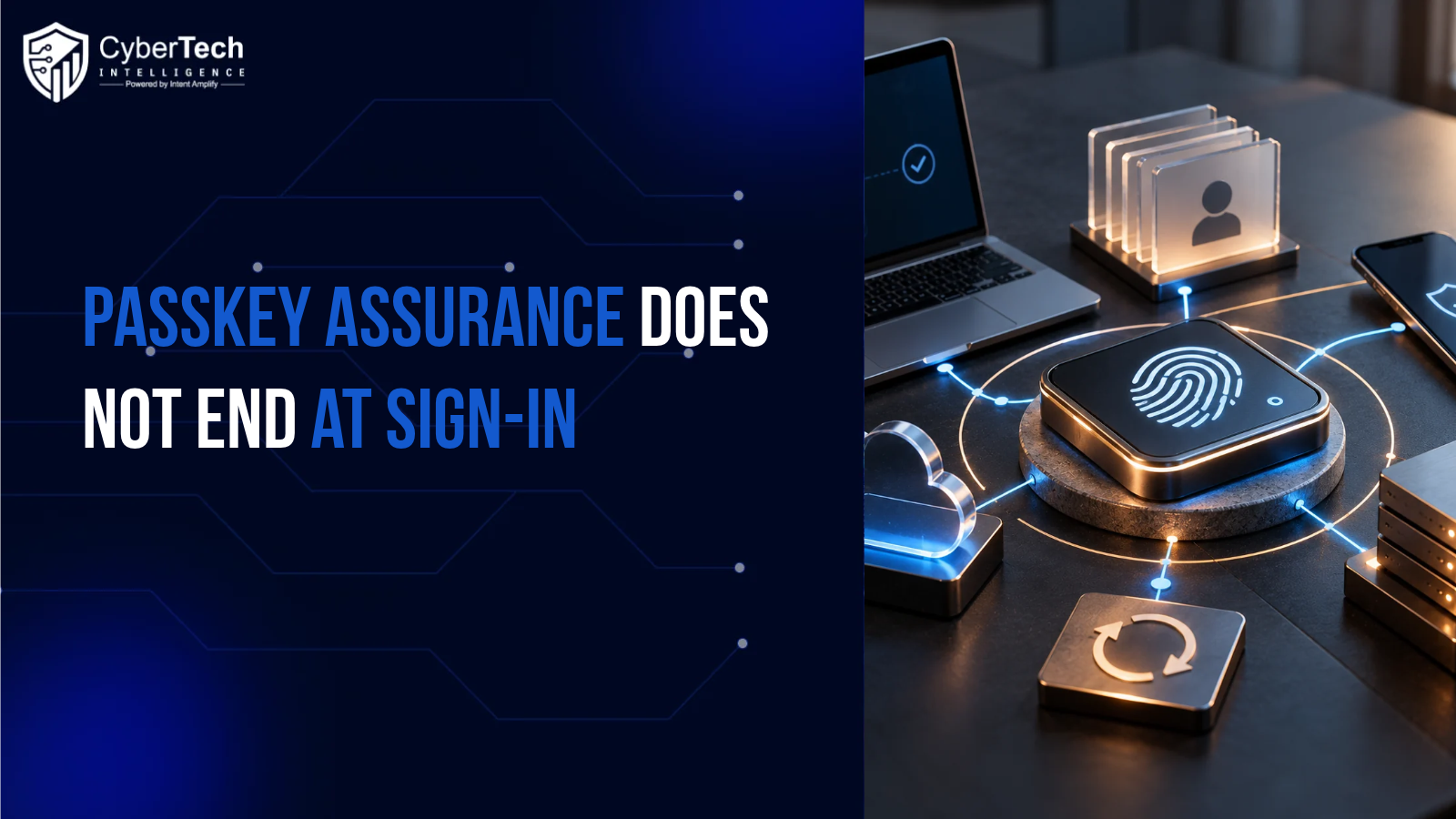
Passkeys strengthen a particular authentication exchange. They do not automatically determine who may restore a lost credential, how a recovery channel is trusted, or how existing application sessions react when account identity changes. The operating risk is created at the handoffs between those responsibilities. A mature program uses one account-state narrative from sign-in through recovery and back to normal use.
NIST’s current session guidance emphasizes reauthentication, timeouts and the independence of identity-provider and relying-party sessions in federated arrangements. [1] That distinction matters operationally: changing a factor at the identity provider does not necessarily prove that every downstream application session has been invalidated.
Job 1. Inventory Every Way an Account Can Change Control
Document not only passkey sign-in but password fallback, backup factors, recovery code use, support escalation, changed phone numbers, and authenticator addition. Map which system decides each transition.
An account map is complete enough for decision-making when a reviewer can follow a lost-device case without guessing which service holds the next approval. An undocumented path is an investigation item, not proof of compromise.
Job 2. Bind Recovery to Adequate Proof
Compare the evidence required during normal sign-in with that required to add a new authenticator. A low-assurance channel may be appropriate for notification without being sufficient for account takeover.
A security team should be able to identify a control owner who explicitly accepted the method. The acceptance should consider fraud risk, accessibility, user impact and reasonable alternative recovery routes.
Job 3. Treat Sessions as a Separate Control Plane
The session secret can sustain access after the initial public-key transaction. Review cookie settings, server-side expiry, regeneration at privilege changes, and what happens after credential reset.
OWASP recommends renewing session identifiers when privilege changes and enforcing server-side logout and expiration. [2] A successful recovery should not be interpreted as evidence that every independent session is terminated unless the implementation checks it.
Job 4. Protect Connected Authorization Flows
Authentication often crosses mobile apps, external identity providers, and API authorization protocols. Review exactly which component authorizes a sensitive change and which tokens remain valid.
OWASP OAuth2 guidance covers authorization-code protection and token handling. [3] These controls solve specific protocol problems; they do not substitute for verifying the legitimacy of the person who requested account recovery.
Job 5. Make Sensitive Changes Deliberate
Adding an authenticator, changing recovery addresses or modifying permissions should be treated as state-changing operations requiring the right authority and, when appropriate, fresh verification.
OWASP CSRF guidance illustrates how browsers may submit authenticated requests that are not genuinely intended by the user. [4] Application design should ensure that the account-change decision is deliberate and authorized, not inferred from cookie presence alone.
Operating Model Comparison
|
Question |
Fragmented approach |
Evidence-led approach |
|
Account map |
Sign-in chart only |
Full recovery and change path |
|
Recovery |
Help-desk script without proof rule |
Method, reviewer and decision record |
|
Sessions |
Assume sign-out is universal |
Test IdP and application invalidation |
|
Sensitive changes |
Treat logged-in state as sufficient |
Apply appropriate fresh assurance |
|
Buyer proof |
Broad passkey security statement |
Demonstrable product control boundary |
An often-missed handoff sits between the identity service and the application whose resources the user wants to access. A service might register a new passkey correctly and still leave an application session that was established earlier. In a federated environment, the identity provider may control authentication while the application controls its own authorization and session expiry. Teams should test both ends of that relationship, rather than infer application behavior from an identity-provider event.
Another handoff involves fraud or security analytics. A sequence of recovery attempts, contact changes and credential registrations may be relevant context, but a high-risk score alone is not proof that a request is malicious. The response policy should specify what happens when signals conflict with a legitimate user’s explanation. Good operations retain the distinction between an event, an alert, a review and a confirmed incident.
The operating model also needs a privacy boundary. Session and device attributes can help reviewers assess unusual access, yet indiscriminate collection increases privacy obligations and may produce noisy decisions. Log the minimum reliable facts necessary for a specific control; use approved retention periods, role-based access and audit trails. Design reviewers should ask who can see recovery evidence and how an individual may challenge an erroneous outcome.
Recovery quality can be measured without claiming to know the total amount of fraud prevented. Define the percentage of tested recovery routes with an approved method, the share of sensitive credential additions supported by fresh authorization evidence, and the share of expected application sessions that were terminated in a controlled recovery test. Each measure requires a denominator and a named owner. A change in those process indicators provides an accountable improvement signal even when no verified malicious event exists.
For a vendor demonstration, bring a representative lost-device scenario. Ask the supplier to point out each event it would observe, the policy it could enforce, and the step that remains a customer or partner responsibility. A concise diagram of those boundaries gives technical evaluators and commercial stakeholders a common vocabulary. That is more useful than broad “zero trust” positioning that never identifies the evidence behind the claim.
Commercial Implications for Cybersecurity Vendors
The operating-model problem creates more useful buyer questions than a generic “passwordless transformation” campaign. CISOs need an accountable residual-risk decision. Identity Architects require event coverage and integration boundaries. Product leaders need an acceptable recovery experience. Fraud and Security Operations need sufficient signals to distinguish support needs from suspected abuse.
CyberTech Intelligence services describe diagnostic work around missed buyer signals, buying-group coverage and messaging alignment. [5] A vendor could apply these methods to separate education from evaluation: publish a recovery-path diagram, offer a technical checklist for engineering, and seek an executive conversation only after a customer explains its actual project. It would be inaccurate to claim that every account expressing interest has a project, or that product-category membership proves purchase intent.
Sales and marketing evidence should stay as specific as security evidence. A content request is engagement. A documented requirement and accepting owner can support qualification. A scheduled discussion is not an attended meeting. An opportunity belongs in CRM only after the agreed commercial definition is met.
Strategic Recommendations
First, choose one account class that carries material business consequences, such as a privileged account, and document its ordinary sign-in, exception and recovery states. Second, rehearse a lost-device case and a disputed passkey-registration event using an agreed evidence checklist. Third, test whether previously issued sessions remain usable after an authorized recovery.
Fourth, record each vendor capability at the layer it actually covers. A tool that flags unfamiliar device enrollment should not be described as verifying every recovery identity. Fifth, join Security, Identity Engineering, Customer Support and the application owner around the same change log so that an incident review can reconstruct the decision without relying on private messages.
CyberTech Intelligence Perspective: Evidence-Led Demand
For the GTM team, account recovery is a useful conversation only when translated into buyer language. Buyer intelligence identifies whether the stakeholder is trying to reduce fraud exposure, improve user continuity, evaluate identity controls or prepare a board assurance update. Managed demand generation delivers relevant content with transparent source boundaries. Pipeline activation follows verified interest, an understood buying role and a mutually accepted action. These are execution options, not claims of realized pipeline.
At the next identity operating-model review, trace a single account recovery event from request to restored session. Record which system owns each decision and which evidence an auditor or buyer could inspect
References and Source Boundaries
Numbered citations identify the primary source for the surrounding statement. Standards and industry guidance describe risks and practices; they do not prove that a named customer has experienced an attack, that a particular vendor product has passed a test, or that a campaign has generated revenue. Source review date: October 23, 2026.
- NIST. SP 800-63B-4: Session Management. Use in this asset: Session timeouts, reauthentication and federated session separation. URL: https://pages.nist.gov/800-63-4/sp800-63b/session/
- OWASP. Session Management Cheat Sheet. Use in this asset: Session invalidation, regeneration and server-side expiration. URL: https://cheatsheetseries.owasp.org/cheatsheets/Session_Management_Cheat_Sheet.html
- OWASP. OAuth2 Cheat Sheet. Use in this asset: Authorization code and token protocol controls. URL: https://cheatsheetseries.owasp.org/cheatsheets/OAuth2_Cheat_Sheet.html
- OWASP. Cross-Site Request Forgery Prevention Cheat Sheet. Use in this asset: Authorization of state-changing session requests. URL: https://cheatsheetseries.owasp.org/cheatsheets/Cross-Site_Request_Forgery_Prevention_Cheat_Sheet.html
- CyberTech Intelligence. About CyberTech Intelligence. Use in this asset: CTI-described research, vendor engagement and market intelligence. URL: https://cybertechintelligence.com/about-us