
A Relationship Is Valuable Because It Is Known
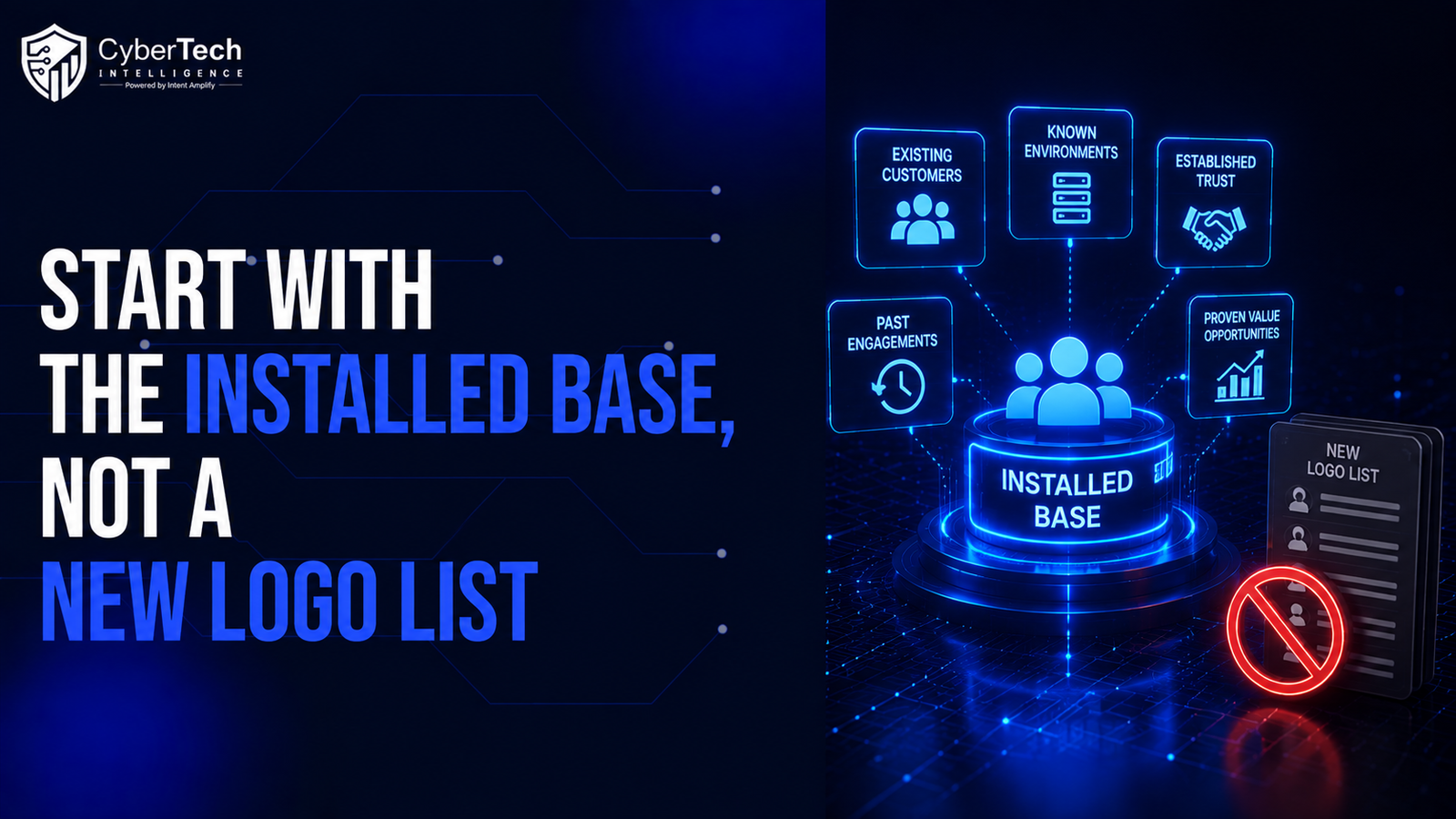
The core advantage of an installed-base motion is not that expansion is guaranteed. It is that the route is identifiable. When a cybersecurity vendor can confirm an MSP, MSSP, channel, service-provider, or customer relationship, it can ask a better first question: is there a relevant security-operations problem that this relationship is positioned to discuss? That is more disciplined than starting from a broad account universe and assuming the existence of a partner path.
Trust Must Be Earned Again for the New Offer
CISA’s Secure by Demand guide encourages software customers to examine how manufacturers approach product security and notes that the questions can also be used in discussions with third-party resellers or service providers. [1] The implication for expansion is straightforward: an existing commercial relationship does not remove the need to explain product security, data use, responsibility, and operating controls. Every new service or AI-enabled workflow has to earn its own trust.
AI Risk Management Belongs in the GTM Story
NIST’s AI Risk Management Framework is voluntary, but it provides a useful governance lens for how organizations design, develop, use, and evaluate AI systems. [2] For GTM teams, the practical translation is simple: state what the AI does, what information it uses, where people remain responsible, and how the workflow is reviewed. This makes the commercial message more credible and reduces the temptation to use “AI-native” as an unsupported performance claim.
An Agent Is Also an Access Question
Microsoft describes Security Copilot agents as autonomous and adaptive automation with the team fully in control. Google’s 2026 IAM update emphasizes unique agent identities, access management, guardrails, and runtime defense. CrowdStrike similarly discusses AI agents as identities that may access systems, APIs, and applications. [3] [4] [5] The important GTM insight is that agentic capability and access governance are part of the same customer conversation.
CyberTech Intelligence Perspective
Use the installed base as a qualification advantage, not a marketing shortcut. Confirm the relationship, choose one customer outcome, document the role of AI, define the human-control boundary, and then ask whether the partner and customer want to explore the use case. This keeps the outreach useful even when the answer is “not now.”
Build the Model Before You Scale It
Confirm one relationship and one internal owner.
Identify the smallest customer segment where the conversation makes sense.
Write the business outcome in one sentence before describing the technology.
List the approved product capabilities and the claims that are not permitted.
Name the data, integrations, permissions, and human decisions involved in the AI-supported workflow.
Give the partner a short qualification path and a clear handoff to Sales or Services.
Review actual results before using the same motion across the wider installed base.
Standards and Evidence Mapping
The evidence set for this asset is deliberately bounded. Government and NIST material is used for risk-management or governance context. Vendor material is used only to describe the publisher’s own documented security-operations direction or capabilities. No source is used to infer a target account’s installed base, buying intent, local security weakness, AI maturity, or expected commercial outcome. [1] [2] [3] [4] [5]
Visual Decision Architecture
The following models convert the campaign thesis into a repeatable sequence for relationship validation, offer design, AI governance, partner activation, qualification, measurement, and executive review. They are CyberTech Intelligence synthesis tools, not claims that every vendor, MSP, or customer follows the same path.
Installed Base to Cybersecurity Pipeline Path
Figure 1. Installed Base to Cybersecurity Pipeline Path - From Confirmed Relationship to Measured Next Step
|
Stage |
Operating Meaning |
|---|---|
|
1. Confirm the route |
Verify the MSP, channel, service-provider, or customer relationship before using installed-base language. |
|
2. Define the outcome |
Choose one customer security outcome the relationship can credibly address. |
|
3. Map the offer |
Use only approved capabilities; separate product facts from campaign goals. |
|
4. Set the AI boundary |
Name the AI-supported task and where human review is required. |
|
5. Activate and qualify |
Use one message, CTA, qualification path, and handoff. |
|
6. Measure and scale |
Use actual funnel and delivery evidence to decide what expands. |
AI-Native SecOps Expansion Decision Workflow
Figure 2. AI-Native SecOps Expansion Decision Workflow
|
Decision Step |
Required Outcome |
|---|---|
|
1. Confirm relationship and owner |
Record the route, owner, scope, and evidence that installed-base language is appropriate. |
|
2. Choose a bounded segment |
Define the eligible group and business outcome. |
|
3. Validate offer and delivery |
Confirm approved capabilities, data, integrations, service responsibilities, and constraints. |
|
4. Define AI and human controls |
Name AI tasks, approvals, permissions, audit evidence, escalation, and stop conditions. |
|
5. Activate and qualify |
Launch the approved message and qualify whether a real priority and next step exist. |
|
6. Review and scale |
Compare actual evidence with the hypothesis; scale, refine, or stop. |
AI-Native SecOps Expansion Maturity Model
Figure 3. AI-Native SecOps Expansion Maturity Model
|
Maturity |
Operating Pattern |
Leadership Priority |
|---|---|---|
|
Reactive |
Relationship assumptions and product pushes vary by account. |
Verify routes and stop unsupported personalization. |
|
Defined |
Relationships, segments, offer rules, and handoffs are documented. |
Standardize messaging, qualification, and AI boundaries. |
|
Connected |
Channel, Product, Services, Sales, and Marketing share evidence. |
Run one operating model through handoff. |
|
Measured |
Funnel, delivery, exceptions, and CRM outcomes are measured by segment. |
Invest using actual evidence. |
|
Adaptive |
The motion changes with partner, customer, product, and governance evidence. |
Scale only repeatable patterns. |
Governance and Decision Rights
Figure 4. AI-Native SecOps Expansion Governance Framework
|
Decision Stage |
Accountable Owner |
Required Evidence |
Exit Criteria |
|---|---|---|---|
|
Relationship Scope |
Channel / BD / Account Owner |
Named relationship, route, owner, scope, and approved message context. |
Relationship confirmed. |
|
Offer and Segment Fit |
Product Marketing / Product |
Target segment, outcome, approved capabilities, and exclusions. |
Bounded offer approved. |
|
Service and AI Controls |
Security / Delivery / Product |
Data, integrations, permissions, AI tasks, approvals, audit, escalation, and stop conditions. |
Control model documented. |
|
GTM Activation |
Marketing / SDR / Channel |
Message, CTA, qualification, SLA, handoff, and claim rules. |
Launch package executable. |
|
Measurement and Scale |
Revenue Operations / Leadership |
Campaign actuals, CRM opportunities, delivery evidence, feedback, and exceptions. |
Scale decision evidence-based. |
CyberTech Intelligence AI-Native SecOps Expansion Framework™
Eight operating layers connect relationship evidence to a business-first offer, data and service readiness, bounded AI use, human accountability, partner activation, qualification, and evidence-led scale.
Figure 5. CyberTech Intelligence AI-Native SecOps Expansion Framework™ - Eight-Layer Architecture
|
Layer |
Name |
Operating Requirement |
|---|---|---|
|
01 |
Confirm Relationship |
Use installed-base language only when the route and owner are known. |
|
02 |
Prioritize Segment |
Choose the group where the security conversation has a clear reason. |
|
03 |
Package Outcome |
Lead with a business outcome and approved capability language. |
|
04 |
Prepare Data |
Confirm data, integrations, permissions, and service responsibilities. |
|
05 |
Apply AI Carefully |
Use AI for named tasks, not broad autonomy or performance promises. |
|
06 |
Keep Human Control |
Define approvals, escalation, audit, stop conditions, and accountability. |
|
07 |
Activate the Motion |
Use one message, CTA, qualification model, and handoff. |
|
08 |
Measure and Govern |
Scale from actual funnel, delivery, customer, and risk evidence. |
AI-Native SecOps Expansion Readiness Score™
Table. CyberTech Intelligence AI-Native SecOps Expansion Readiness Score™
|
Domain |
Executive Assessment Question |
Ready-State Evidence |
|---|---|---|
|
Relationship Evidence |
Is the MSP, channel, service-provider, or customer route confirmed? |
Named relationship, owner, scope, and current evidence. |
|
Segment Fit |
Is the eligible segment narrow and explainable? |
Inclusion rules, exclusions, outcome, and owner. |
|
Offer Fit |
Is an approved security capability mapped to the outcome? |
Capability map, exclusions, and product owner. |
|
Data and Integration |
Are required data, integrations, permissions, and responsibilities known? |
Data sources, access model, integration plan, and constraints. |
|
AI Workflow |
Is AI limited to named, explainable tasks? |
Workflow, input/output boundary, source documentation, and owner. |
|
Human Oversight |
Are approval, escalation, override, and stop conditions defined? |
Decision rights, audit trail, rollback, and exceptions. |
|
Service Delivery |
Can the service path support and escalate the workflow? |
Service owner, procedure, coverage, handoff, and escalation. |
|
Partner Enablement |
Does the team have a simple message, CTA, qualification, and handoff? |
Approved copy, brief, CTA, questions, and SLA. |
|
Customer Trust |
Are claims, responsibilities, data use, and audit expectations clear? |
Claim rules, responsibility matrix, data terms, and review owner. |
|
Pipeline and CRM |
Are funnel gates explicit and consistently recorded? |
Stage definitions, acceptance criteria, CRM fields, and owners. |
|
Measurement and Expansion |
Will the team measure real outcomes before scale? |
Actual funnel, delivery, feedback, and scale decision. |
How to Calculate the Score
Rate each domain from 0 to 4: 0 = absent; 1 = informal; 2 = documented; 3 = implemented and tested; 4 = measured and continuously improved. The maximum is 44 points. Divide the total by 44 and multiply by 100. Suggested bands are Critical (0-24%), Developing (25-49%), Defined (50-69%), Managed (70-84%), and Adaptive (85-100%). The score is an internal readiness aid. It is not a certification, a revenue forecast, a statement of product performance, or a prediction of customer conversion.
Continue the AI-Native SecOps Expansion Journey
Use this asset to review one confirmed MSP, MSSP, channel, service-provider, or customer route end to end. Validate the relationship, eligible segment, business outcome, approved capability, data and service conditions, AI-supported workflow, human decision rights, qualification path, and the actual evidence required before scale.
Score One Segment Before You Scale
Use the CyberTech Intelligence AI-Native SecOps Expansion Readiness Score™ on one confirmed MSP or channel segment and identify the two or three gaps that matter most before launch.
About CyberTech Intelligence
CyberTech Intelligence provides research-led cybersecurity intelligence, executive content, and market engagement programs. This publication is vendor-neutral and intended for education, decision support, and claim-safe GTM planning.
Research and Citation Governance
This asset uses public sources current through August 25, 2026. Government and NIST sources are used within their stated guidance and risk-management scope. Vendor sources are used only to describe the vendor’s own published product, threat-research, or operating-model statements; they are not treated as independent performance proof. CyberTech Intelligence does not infer that a target account has an MSP installed base, active buying intent, a security gap, a current incident, a particular product capability, or a specific AI operating model. Framework, maturity, and scorecard content are CyberTech Intelligence analysis and are presented as decision aids rather than certification, financial forecast, incident prediction, or guaranteed outcome.
References
[1] Cybersecurity and Infrastructure Security Agency, “Secure by Demand Guide: How Software Customers Can Drive a Secure Technology Ecosystem,” August 2024. https://www.cisa.gov/sites/default/files/2024-08/SecureByDemandGuide_080624_508c.pdf Accessed August 25, 2026. Relevance: Provides questions customers can use to assess product security and notes that the guidance can be used with third-party resellers or service providers.
[2] National Institute of Standards and Technology, “AI Risk Management Framework,” Updated April 7, 2026. https://www.nist.gov/itl/ai-risk-management-framework Accessed August 25, 2026. Relevance: Provides a voluntary risk-management basis for trustworthy design, development, use, and evaluation of AI systems.
[3] Microsoft Learn, “Microsoft Security Copilot Frequently Asked Questions,” Updated 2026. https://learn.microsoft.com/en-us/copilot/security/faq-security-copilot?view=o365-worldwide Accessed August 25, 2026. Relevance: Vendor documentation describing Security Copilot agents as autonomous and adaptive automation while keeping the team in control.
[4] Google Cloud, “What's new in IAM: Security, governance, and runtime defense,” May 6, 2026. https://cloud.google.com/blog/products/identity-security/whats-new-in-iam-security-governance-and-runtime-defense Accessed August 25, 2026. Relevance: Vendor-published guidance on agent identities, access management, guardrails, and runtime defense.
[5] CrowdStrike, “CrowdStrike Announces Continuous Identity for AI Agents,” June 15, 2026. https://www.crowdstrike.com/en-us/blog/crowdstrike-announces-continuous-identity-for-ai-agents/ Accessed August 25, 2026. Relevance: Vendor-published discussion of AI agents as identities that can access systems, invoke APIs, and act autonomously.