
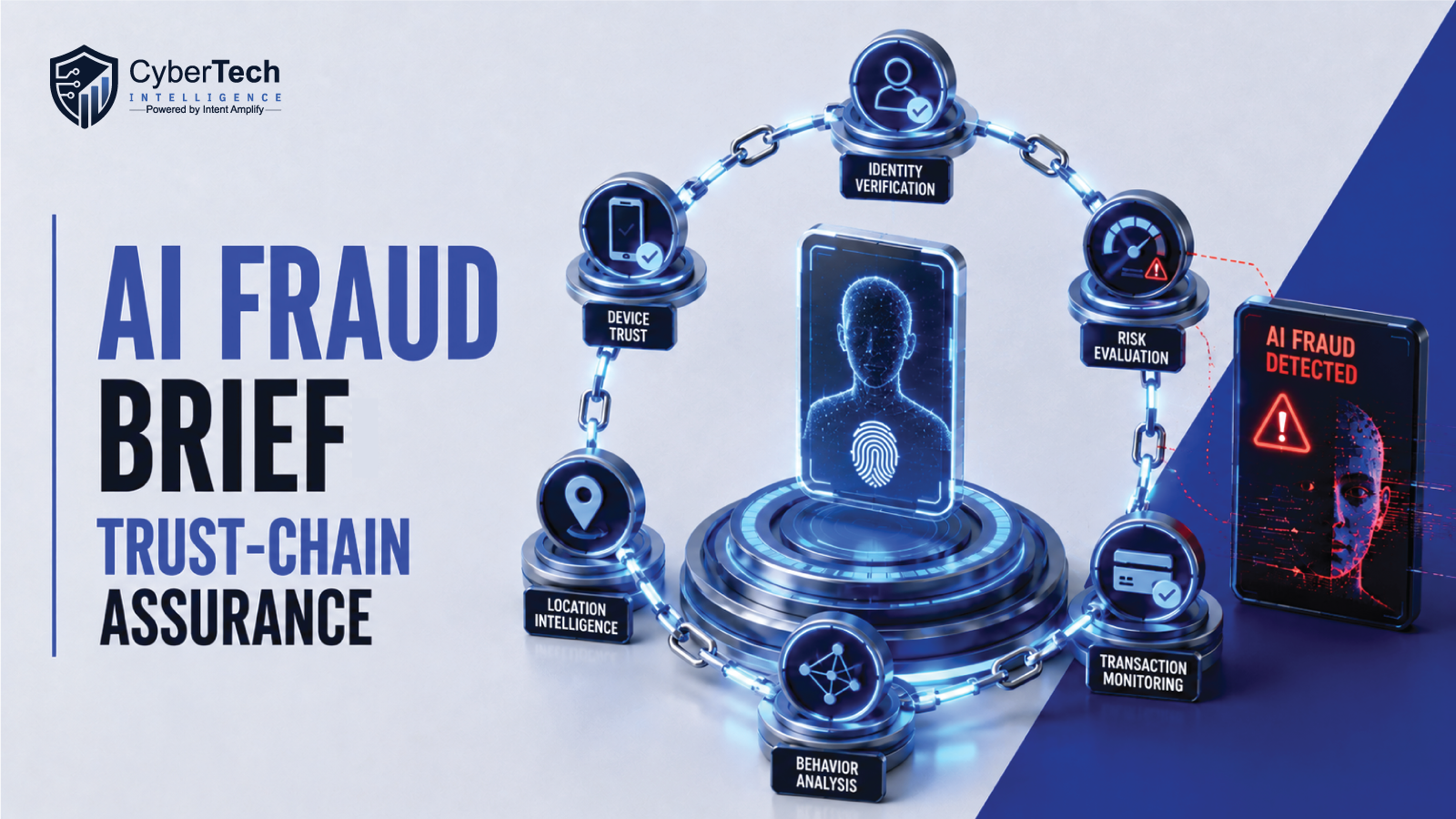
AI-enabled fraud is moving beyond stolen credentials. Criminals can now assemble convincing identities, documents, voices, videos, and payment stories. That means banks can no longer rely on point-in-time verification alone. They need to test whether the identity, interaction, intent, beneficiary, and transaction remain coherent across the full customer journey.
At a Glance
FinCEN has documented suspicious activity involving generative AI and deepfake media targeting financial institutions.
The FBI recorded 22,364 complaints with an AI-related descriptor and $893.3 million in adjusted losses in 2025.
Deloitte estimates that generative AI could push U.S. fraud losses to $40 billion by 2027. This is a forecast, not a current loss total.
Deepfake detection is useful, but it does not prove that a request is legitimate or that a transaction makes sense.
Why This Matters Now
A fraudster no longer needs only a stolen password. AI can support synthetic onboarding, document forgery, cloned voice interactions, account takeover, executive impersonation, beneficiary changes, and laundering through fraudulent accounts.
The result is a connected fraud journey. Identity teams may see liveness anomalies. Cybersecurity teams may see device risk. Fraud teams may see payment behavior. AML teams may see suspicious beneficiary networks. If those signals remain separate, the bank sees fragments instead of the full attack path.
CyberTech Intelligence Perspective
The control objective is shifting from identity assurance to transaction-coherence assurance. The bank must ask whether the person, interaction, purpose, recipient, amount, timing, and movement of funds tell one credible story.
Signal of the Week: Deepfake Media and Fraudulent Accounts
FinCEN has warned about suspected deepfake media used in schemes targeting financial institutions. The U.S. Treasury's 2026 National Money Laundering Risk Assessment also links generative-AI-produced fraudulent identities to accounts used to receive or launder fraud proceeds.
This moves AI fraud from a media-detection issue to a financial-crime workflow issue. A convincing document or voice sample may be only the first step. The downstream risk is account creation, account takeover, payment authorization, beneficiary manipulation, and fund movement.
Control Framework for the Week
Identity: Confirm that a real, authorized person or entity is present at onboarding and critical account changes.
Interaction: Verify the document, device, capture path, voice, video, and session integrity.
Intent: Test whether the action fits the customer's behavior, amount, purpose, and beneficiary relationship.
Interdiction: Preserve the ability to pause, step up, revoke, recall, investigate, and escalate quickly.
Action Checklist
Review whether onboarding, contact-center authentication, account-change controls, beneficiary changes, and payment approvals share evidence.
Map where deepfake risk signals are routed today and whether they trigger payment or beneficiary review.
Define escalation rules for mismatched signals, such as suspicious media, anomalous device, new payee, unusual amount, or urgent payment narrative.
Test callback, dual authorization, cooling-off, hold, recall, and evidence-preservation workflows.
Measure time to hold, time to revoke, time to recall, and prevented-loss evidence.
The Deepfake Defense Playbook: Building AI Fraud Detection and Identity Resilience Across BFSI
Use this eBook to understand how banking teams are operationalizing layered identity verification, behavioral biometrics, recipient controls, and deepfake voice fraud prevention.
Executive Readiness Scorecard
Use the report to assess how identity, fraud, cybersecurity, AML, payment, and contact-center controls operate as one enterprise decision architecture.
The Bottom Line
The strongest fraud programs will not claim one model can detect every fake. They will prove who initiated the action, what changed, who receives value, why the transaction is credible, and how quickly it can be stopped.
About CyberTech Intelligence
CyberTech Intelligence is an enterprise cybersecurity intelligence platform that helps security leaders, technology decision-makers, and go-to-market teams navigate emerging risks through executive-ready research and strategic market insight.
Request an AI Fraud and Deepfake Readiness Assessment
CyberTech Intelligence helps vendors across AI fraud detection, identity verification, behavioral biometrics, AML, payment security, and adjacent financial cybersecurity categories map their capabilities to BFSI buyer priorities and demand opportunities.
Request an AI Fraud and Deepfake Readiness Assessment: Contact Us Today
References
-
FBI. 2025 Internet Crime Report. 2026.
https://www.ic3.gov/AnnualReport/Reports/2025_IC3Report.pdf -
Deloitte. Generative AI Is Expected to Magnify the Risk of Deepfakes and Other Fraud in Banking. 2024.
https://www.deloitte.com/us/en/insights/industry/financial-services/deepfake-banking-fraud-risk-on-the-rise.html -
FinCEN. Alert on Fraud Schemes Involving Deepfake Media Targeting Financial Institutions. 2024.
https://www.fincen.gov/system/files/shared/FinCEN-Alert-DeepFakes-Alert508FINAL.pdf -
U.S. Treasury. 2026 National Money Laundering Risk Assessment. 2026.
https://home.treasury.gov/system/files/246/2026-NMLRA.pdf -
NIST. Reducing Risks Posed by Synthetic Content. 2024.
https://nvlpubs.nist.gov/nistpubs/ai/NIST.AI.100-4.pdf


