
Executive Summary
AI-enabled fraud is reshaping financial trust because it can fabricate the evidence that banks were built to verify. The issue is no longer limited to stolen credentials or reused personal information. Generative AI can support synthetic identities, forged documents, cloned voices, manipulated video, executive impersonation, payment narratives, and fraudulent accounts used to receive or launder funds.
The evidence base points to an urgent control shift. FinCEN has documented suspicious activity involving suspected deepfake media and fraudulent identity documents. The FBI recorded 22,364 complaints carrying an AI-related descriptor and $893.3 million in adjusted losses in 2025. Deloitte estimates that generative AI could push U.S. fraud losses to $40 billion by 2027, compared with $12.3 billion in 2023. Treasury's 2026 National Money Laundering Risk Assessment connects suspected generative-AI-produced fraudulent identities to accounts used for fraud proceeds and laundering.
This report examines why AI-driven fraud requires trust-chain assurance across identity, interaction, intent, and interdiction.
At a Glance
AI-enabled fraud can fabricate identities, biometrics, documents, voices, videos, and transaction narratives.
Point-in-time identity checks are insufficient when attackers manipulate onboarding, access, account changes, beneficiaries, and payments as one connected journey.
Deepfake detection improves transparency, but it does not independently prove legitimate intent.
Fraud, identity, cybersecurity, AML, payment, and contact-center evidence must be correlated before irreversible loss.
Research Finding 1: AI Fraud Expands the Attack Surface
Traditional identity theft depends on stolen information from a real person. AI-driven fraud can blend real, stolen, and fabricated attributes into a convincing identity or authority signal. That expands the attack surface from credential misuse to manufactured evidence.
A forged document, synthetic face, cloned voice, credible executive instruction, or realistic payment narrative can move through systems that were designed to evaluate each signal separately. The risk is highest when a bank's controls confirm individual artifacts without testing whether the whole customer action is coherent.
Research Finding 2: Synthetic Identity and Laundering Risks Are Converging
Treasury's 2026 National Money Laundering Risk Assessment notes that malicious actors have opened accounts using fraudulent identities suspected to have been produced with generative AI and used those accounts to receive or launder fraud proceeds.
This links identity fraud to downstream financial crime. An account opened with synthetic or manipulated evidence is not only an onboarding failure. It may become infrastructure for payment fraud, money movement, account layering, and laundering.
CyberTech Intelligence Perspective
Every high-risk identity event should be evaluated for downstream transaction use. If suspicious identity evidence appears at onboarding or account change, the bank should understand what value movement that identity can enable.
Research Finding 3: Deepfake Detection Must Be Part of a Larger Decision
NIST has explained that provenance, watermarking, labeling, and synthetic-media detection can improve transparency. However, these methods do not by themselves prove that content is trustworthy, legitimate, or being used in an authentic context.
This matters because the fraud decision is broader than media authenticity. A real video can be used to support social engineering. A synthetic voice can trigger a payment. A legitimate user may be coerced. A false beneficiary can receive funds even when identity checks appear strong.
Research Finding 4: Transaction Coherence Is the New Assurance Layer
The next control layer is transaction coherence: whether the person, device, behavior, request, recipient, amount, timing, and payment purpose tell the same credible story.
Banks should correlate identity proofing, device intelligence, behavioral biometrics, session risk, account history, contact-center signals, beneficiary change history, payment velocity, and AML indicators. The objective is not to make every interaction friction-heavy. It is to apply friction where authority or money movement becomes high consequence.
AI Fraud Maturity Model
Point-in-Time Identity: Documents, selfies, credentials, and onboarding checks. Evidence: KYC pass rates, false accepts, manual-review outcomes, and suspicious identity flags.
Adaptive Identity Control: Device intelligence, liveness, behavioral biometrics, and step-up authentication. Evidence: challenge outcomes, risk-score changes, recovery exceptions, and account-change reviews.
Transaction Coherence: Beneficiary history, payment velocity, amount, purpose, customer behavior, and account history. Evidence: holds, prevented losses, anomalous-payee reviews, and callback outcomes.
Orchestrated Interdiction: Coordination across fraud, cyber, identity, AML, payments, and contact centers. Evidence: time to hold, revoke, recall, investigate, and escalate.
Board-Ready Evidence: Exposure, customer friction, control effectiveness, and loss outcomes. Evidence: executive dashboards, incident chronology, exception registers, and prevented-loss value.
Executive Readiness Questions
Can the bank connect suspicious identity, device, session, beneficiary, and payment evidence into one case?
Which deepfake or synthetic-media signals reduce authority automatically?
Can teams pause a payment or beneficiary change when identity evidence conflicts with behavior?
Are contact-center controls integrated with fraud, payment, and AML decisioning?
Can the bank measure time to hold, time to revoke, time to recall, and prevented-loss value?
Does executive reporting show control effectiveness, not only alert volume?
Conclusion
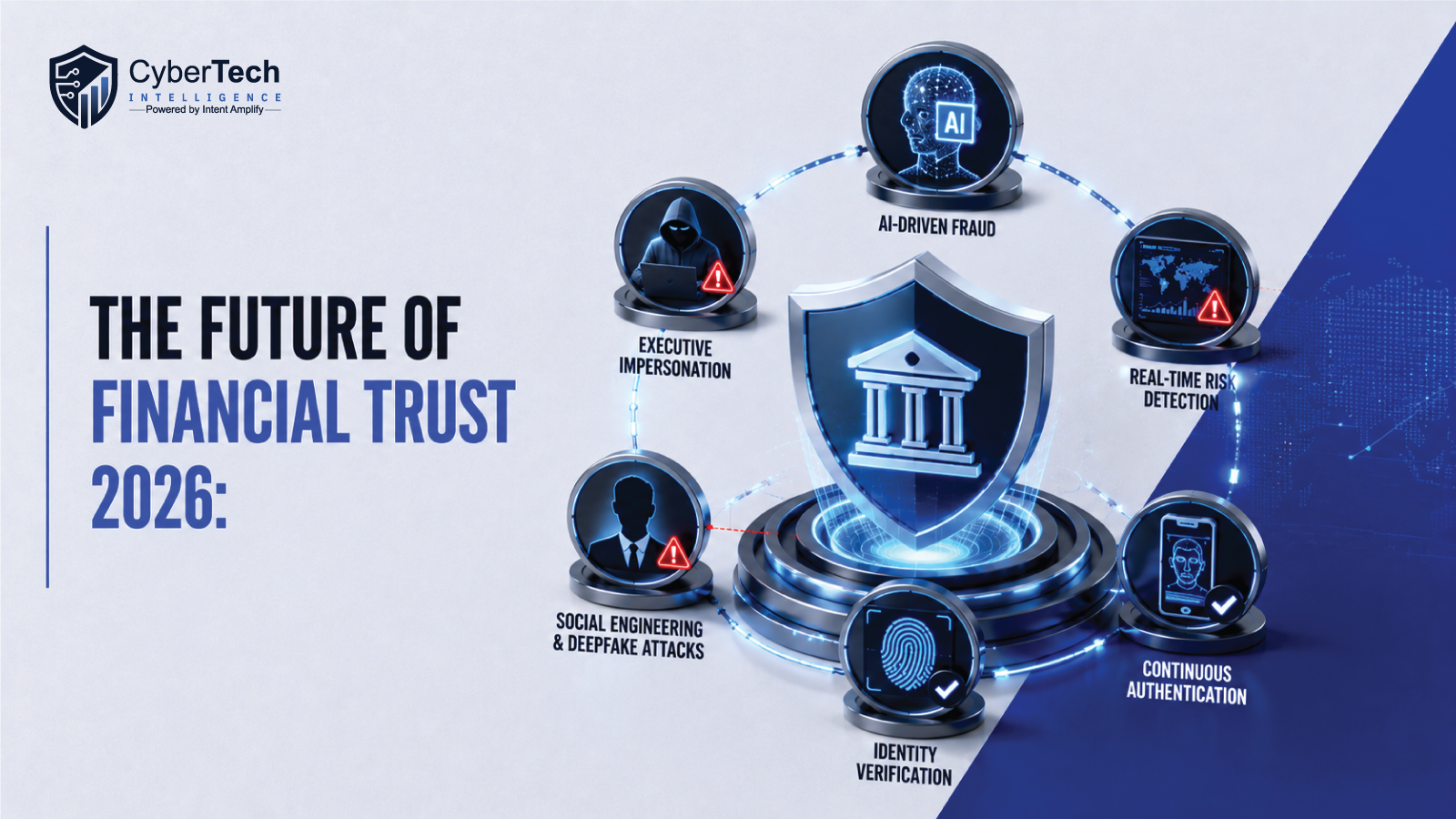
The future of financial trust will not depend on one model that detects every fake. It will depend on connected assurance. Banks need to prove who initiated the action, what changed, who receives value, why the transaction is credible, and how quickly suspicious activity can be contained.
AI fraud defense requires a continuous trust model: establish identity, verify interaction integrity, test intent, scrutinize the recipient, and preserve evidence.
About CyberTech Intelligence
CyberTech Intelligence is an enterprise cybersecurity intelligence platform that helps security leaders, technology decision-makers, and go-to-market teams navigate emerging risks through executive-ready research and strategic market insight.
Request an AI Fraud and Deepfake Readiness Assessment
CyberTech Intelligence helps vendors and enterprise teams map AI fraud detection, identity verification, behavioral biometrics, AML, payment security, and adjacent financial cybersecurity capabilities to BFSI buyer priorities and readiness gaps.
Request an AI Fraud and Deepfake Readiness Assessment: Contact Us Today
References
- FBI. 2025 Internet Crime Report. 2026.
https://www.ic3.gov/AnnualReport/Reports/2025_IC3Report.pdf - Deloitte. Generative AI Is Expected to Magnify the Risk of Deepfakes and Other Fraud in Banking. 2024.
https://www.deloitte.com/us/en/insights/industry/financial-services/deepfake-banking-fraud-risk-on-the-rise.html - FinCEN. Alert on Fraud Schemes Involving Deepfake Media Targeting Financial Institutions. 2024.
https://www.fincen.gov/system/files/shared/FinCEN-Alert-DeepFakes-Alert508FINAL.pdf - U.S. Treasury. 2026 National Money Laundering Risk Assessment. 2026.
https://home.treasury.gov/system/files/246/2026-NMLRA.pdf - NIST. Reducing Risks Posed by Synthetic Content. 2024.
https://nvlpubs.nist.gov/nistpubs/ai/NIST.AI.100-4.pdf - Entrust. 2026 Identity Fraud Report. Vendor-produced research.
https://www.entrust.com/resources/reports/identity-fraud-report


