
AI Has Changed the Economics of Business Email Compromise
Business Email Compromise is no longer only an email fraud problem. In 2026, it has turned into a synthetic trust problem, where attackers use artificial intelligence to imitate executives, vendors, finance leaders, legal teams, and business partners with a level of realism that traditional awareness training was never built to address.
The risk is financial, immediate, and often irreversible. The FBI’s 2025 Internet Crime Report recorded 1,008,597 cybercrime complaints and more than $20.877 billion in reported losses, a 26% increase from the prior year.¹ Business Email Compromise remained one of the most financially damaging categories, generating $3.046 billion in reported losses across 24,768 complaints.¹
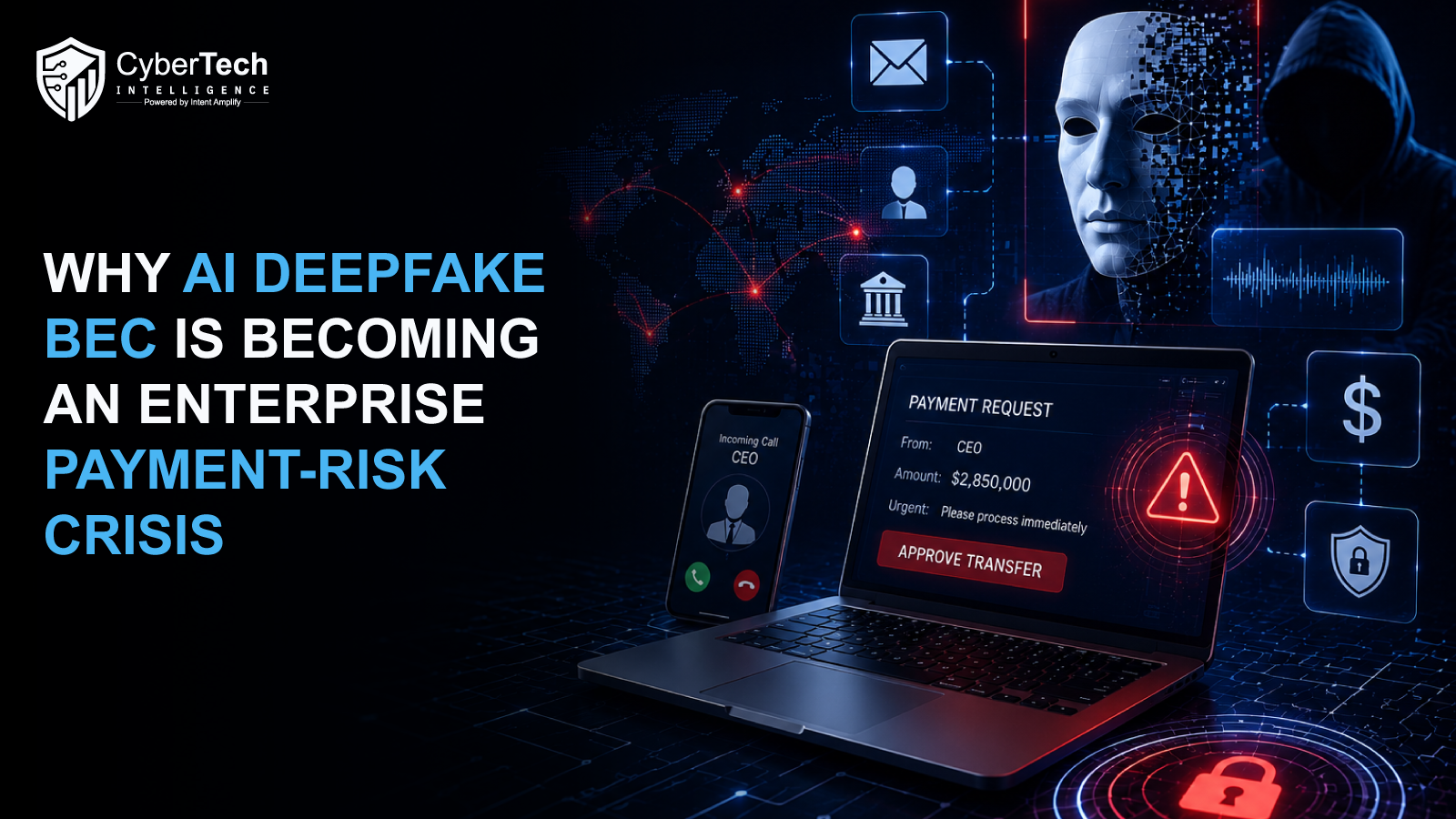
For enterprise leaders, the problem is not only that BEC is expensive. The larger issue is that AI makes BEC harder to detect before money leaves the organization. A fraudulent email may now arrive without spelling mistakes, awkward tone, or suspicious formatting. A follow-up call may use a cloned executive voice. A video meeting may include a synthetic identity. The attack works because it abuses trust, urgency, and authority rather than malware.
CyberTech Intelligence Perspective
CyberTech Intelligence views AI-enabled BEC as a financial trust governance problem, not only an email security issue. The core risk is no longer limited to whether an email, voice, or video appears authentic. The real risk is whether enterprise payment workflows still rely on human recognition, executive authority, urgency, or familiar communication patterns as proof of legitimacy.
As deepfake voice, synthetic video, AI-generated writing, and compromised identities become more convincing, organizations must redesign payment authorization around independently verifiable controls. Trust should be confirmed through process, identity, workflow governance, and pre-approved verification channels rather than through the perceived authenticity of a message or call.
For CFOs, CISOs, CIOs, treasury leaders, procurement teams, and board risk committees, AI Deepfake BEC should be treated as a payment governance and enterprise resilience issue.
Why Deepfake BEC Is Harder to Stop Than Traditional Fraud
Traditional BEC often relied on email compromise, vendor impersonation, invoice manipulation, or executive spoofing. These methods still matter, but AI adds a second channel of persuasion. Attackers can now combine a convincing email with a voice call, chat message, or video confirmation that appears to validate the request.
This is why deepfake BEC is so dangerous for finance teams. Many organizations still approve urgent transfers, vendor banking changes, acquisition payments, tax documents, or legal settlements through workflows that depend on human recognition. If a finance director hears what sounds like the CFO confirming a transfer, the organization’s control model may fail even when email security tools do not.
Microsoft’s Digital Defense Report 2025 shows how financial cybercrime is becoming more automated and commercially organized, with attackers using AI to improve targeting, language quality, and scale.² Microsoft also reported that cybercriminals and nation-state actors generate more than 600 million attacks daily across its telemetry, which shows why manual review alone cannot keep pace with modern threat volume.²
Voice Phishing Is Now a Cloud and Identity Risk
AI deepfake BEC should not be treated only as an email security issue. It also intersects with identity, cloud access, and help-desk workflows. Attackers increasingly use voice phishing to manipulate employees into approving logins, resetting credentials, revealing one-time codes, or changing payment details.
Google Cloud/Mandiant’s M-Trends 2026 found that voice phishing became the top initial access vector for cloud-related compromises, accounting for 23% of cloud incidents where an initial vector was identified.³ The same report also noted that some adversary activity can move from a minor alert to major compromise through a hand-off in less than 30 seconds.³
For enterprise security leaders, this creates a difficult operating reality. A deepfake call may not be the final fraud step. It may be the entry point into identity compromise, SaaS access, cloud abuse, or payment workflow manipulation. Once attackers obtain legitimate access, they can operate through trusted systems and bypass controls that are tuned to detect malware rather than authority abuse.
AI Adoption Is Outpacing AI Fraud Governance
Enterprise AI adoption is expanding quickly, but governance is not keeping pace. Microsoft’s Cyber Pulse: An AI Security Report found that more than 80% of the Fortune 500 are deploying active AI agents, while only 47% of organizations report implementing specific generative AI security controls.⁴ Microsoft also reported that 29% of employees have used unsanctioned AI agents for work tasks.⁴
These figures matter because the same AI tools that improve enterprise productivity are also changing fraud expectations. Employees are becoming more accustomed to AI-generated content, synthetic assistants, automated messages, and digital interactions that feel human. That normalization makes it harder to identify impersonation based only on tone, fluency, or visual realism.
Cisco’s The Agent Trust Gap found that 85% of organizations are experimenting with, piloting, or deploying agentic AI, but only 5% have reached broad production, while nearly 60% of security leaders cite security concerns as the primary barrier to wider adoption.⁵ The trust gap is not limited to enterprise AI systems. It also applies to fraud defense because organizations must now verify whether the person, voice, message, and request are legitimate before approving financial action.
CyberTech Intelligence Research Desk Observation
Enterprise AI adoption is normalizing synthetic communication faster than governance models are evolving. Organizations that continue relying on familiar voices, recognizable writing styles, executive urgency, or video presence as evidence of authenticity will face increasing payment risk.
Sustainable resilience will depend on independently verified workflows rather than human perception. The strongest organizations will not ask employees to detect every deepfake. They will design financial workflows where deepfake realism cannot independently authorize money movement, vendor changes, payroll updates, or sensitive document release.
Why Finance Controls Must Change
Deepfake BEC succeeds when one channel is enough to approve a high-risk action. If an email, call, video meeting, or chat message can authorize a payment change by itself, the control model is already exposed.
The most effective response is not asking employees to become deepfake experts. The better response is designing workflows where the authenticity of the message is not the deciding factor. High-risk actions should require out-of-band verification through pre-registered contact details, dual approval, callback procedures, transaction holds, and independent vendor validation.
A finance team should not approve new banking details because an executive sounds convincing. A procurement team should not change supplier payment information because a vendor's email looks legitimate. A legal team should not release funds because an urgent video call appears to confirm the request.
Cloudflare’s 2026 Cloudflare Threat Report reported that 63% of logins involved credentials already compromised elsewhere during a recent 3-month telemetry window, while 94% of login attempts originated from bots.⁶
Those figures show why payment controls must be tied to identity and bot defense as well as email protection. Attackers are not only sending messages; they are also testing credentials, automating login attempts, and abusing trusted platforms.
CyberTech Intelligence Enterprise Financial Trust Framework™
|
Framework Pillar |
Executive Question |
What Leaders Should Measure |
|
Executive Verification |
Are executive requests verified through trusted channels before action? |
Callback controls, pre-approved contacts, executive impersonation checks, urgent request escalation, and verification completion rate. |
|
Identity Assurance |
Can the organization detect compromised or suspicious identities around finance workflows? |
Unusual logins, new devices, impossible travel, OAuth abuse, mailbox rules, MFA events, and payment-system access anomalies. |
|
Independent Authorization |
Can high-risk financial actions be approved without relying on one communication channel? |
Dual approval, segregation of duties, out-of-band confirmation, payment thresholds, and exception handling. |
|
Payment Governance |
Are wire transfers, vendor banking changes, payroll changes, and emergency payments controlled? |
Transaction holds, vendor validation, approval logs, cooling-off periods, payment-change reviews, and fraud exceptions. |
|
Workflow Integrity |
Are finance, procurement, legal, and treasury workflows protected from urgency-based manipulation? |
Escalation rules, workflow auditability, request source validation, approval-chain integrity, and business process testing. |
|
Vendor Assurance |
Are vendor payment instructions independently validated? |
Vendor master-file reviews, banking-change verification, third-party callback records, supplier contact governance, and change history. |
|
Board Oversight |
Is AI-enabled payment fraud reported as an enterprise risk? |
Fraud attempts, blocked transactions, verification failures, training outcomes, response readiness, and governance maturity. |
The priority is to eliminate single-channel authorization for wire transfers, vendor banking changes, payroll changes, and emergency payments. Any request above a defined threshold should require independent confirmation through a known phone number or secure workflow that cannot be supplied inside the suspicious message itself.
The second priority is to create mandatory cooling-off periods for vendor banking changes. A 24 to 48-hour hold can neutralize urgency-based fraud because deepfake BEC depends on emotional pressure and time compression.
The third priority is to monitor identity behavior around finance systems. Unusual logins, impossible travel, new devices, suspicious mailbox rules, OAuth abuse, and abnormal payment-system access should trigger immediate review.
The fourth priority is to retrain employees around verification reflexes rather than visual or audio detection. Employees should not be expected to identify every synthetic voice or video. They should be trained to stop, verify, and escalate when requests involve money movement, credentials, sensitive files, or executive urgency.
Executive Financial Trust Scorecard
|
Readiness Area |
Early Stage |
Developing |
Mature |
|
Payment Authorization Maturity |
High-risk payments may still be approved through email, calls, or chat alone. |
Dual approval exists for some payments, but exception handling is inconsistent. |
High-risk payments require independent verification, dual approval, audit logs, and workflow-based authorization. |
|
Executive Verification Controls |
Executive requests are verified informally by employees. |
Callback and escalation procedures exist, but adoption varies by team. |
Executive requests are verified through pre-approved channels and cannot be approved through the requesting message itself. |
|
Vendor Governance |
Vendor banking changes are handled through manual review. |
Vendor validation exists, but cooling-off periods and independent confirmation are inconsistent. |
Vendor banking changes require verified contacts, transaction holds, approval logs, and independent validation. |
|
Identity Assurance |
Finance identity monitoring is limited to standard login alerts. |
Suspicious login and mailbox activity are reviewed for selected users. |
Finance, treasury, procurement, and executive identities are monitored for abnormal access, OAuth abuse, mailbox rules, and payment-system activity. |
|
Workflow Integrity |
Controls depend heavily on employee judgment. |
Some high-risk workflows have approval rules. |
Payment, procurement, legal, and treasury workflows are designed so no single synthetic communication can authorize action. |
|
Fraud Response Readiness |
Fraud response begins after money movement is discovered. |
Incident playbooks exist but are not fully tested against deepfake BEC scenarios. |
Fraud response includes bank escalation, legal review, cyber investigation, executive notification, and transaction recovery procedures. |
|
Board Reporting Maturity |
Reporting focuses on phishing training or fraud losses. |
Leadership receives periodic updates on BEC risk. |
Boards receive metrics on payment governance, verification failures, fraud attempts, identity risk, and financial resilience. |
Conclusion
AI-enabled Business Email Compromise (BEC) remains underestimated because it targets business processes instead of technical control failures. These attacks frequently avoid malware deployment, software exploitation, and traditional incident indicators while manipulating trusted employees into authorizing fraudulent financial transactions.
Enterprise resilience depends on governance that reduces reliance on individual judgment. Mature organizations strengthen payment authorization through independent identity verification, multi-party approval, segregation of duties, and out-of-band confirmation for high-risk transactions. In AI-enabled fraud environments, payment integrity depends on verifiable authorization supported by governance and process controls rather than the perceived authenticity of a message, voice, or video.
Assess Your Enterprise Financial Trust Readiness
CyberTech Intelligence helps CFOs, CISOs, CIOs, treasury leaders, procurement teams, enterprise risk leaders, and board risk committees strengthen payment governance against AI-enabled fraud. Through the Enterprise Financial Trust Assessment, organizations can evaluate payment governance maturity, executive verification controls, AI-enabled fraud resilience, identity governance, workflow integrity, vendor assurance, and board oversight.
CyberTech Intelligence also supports enterprise teams through:
- AI Deepfake BEC Readiness Review
- Payment Authorization and Vendor Change Assessment
- Executive Verification Control Review
- Cloud Identity and Finance Workflow Risk Review
- Board-Level Financial Trust Briefing
Use this blog as the starting point for a structured governance conversation that connects AI-enabled fraud, payment authorization, identity assurance, workflow integrity, and enterprise financial resilience.
References
- Federal Bureau of Investigation, 2025 Internet Crime Report, April 2026
https://www.ic3.gov/AnnualReport/Reports/2025_IC3Report.pdf - Microsoft, Microsoft Digital Defense Report 2025, October 2025
https://cdn-dynmedia-1.microsoft.com/is/content/microsoftcorp/microsoft/final/en-us/microsoft-brand/documents/Microsoft%20Digital%20Defense%20Report%202024%20%281%29.pdf? - Google Cloud / Mandiant, M-Trends 2026 Report: Executive Edition, 2026
https://www.gstatic.com/security-marketing/m-trends-2026-en.pdf - Microsoft, Cyber Pulse: An AI Security Report, February 2026
https://www.microsoft.com/en-us/security/security-insider/emerging-trends/cyber-pulse-ai-security-report - Cisco, The Agent Trust Gap: What Our Research Reveals About Agentic AI Security, March 2026
https://blogs.cisco.com/security/the-agent-trust-gap-what-our-research-reveals-about-agentic-ai-security - Cloudflare, Introducing the 2026 Cloudflare Threat Report, March 2026
https://blog.cloudflare.com/2026-threat-report/


Author
Omkar Waghmare
Author