
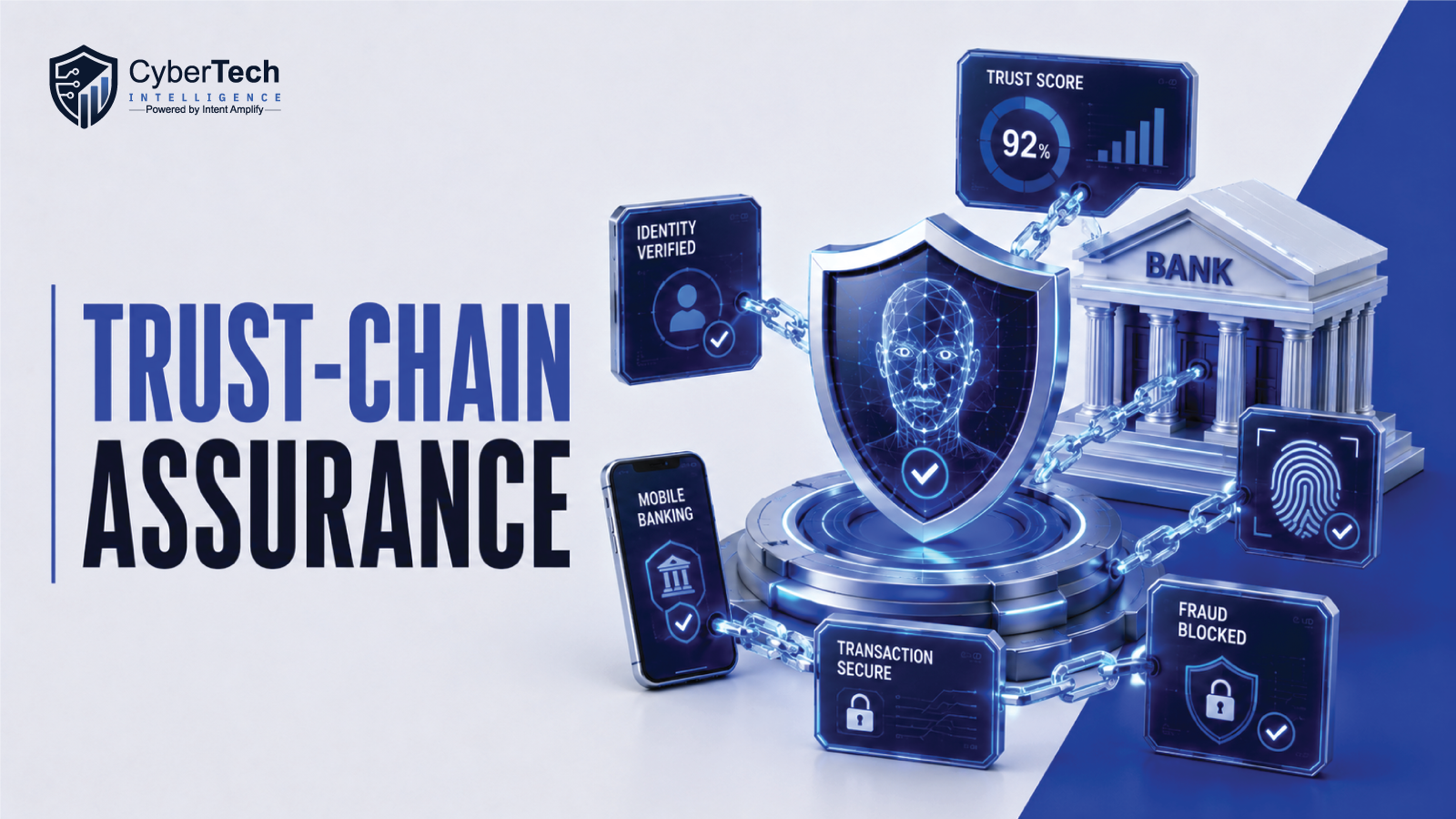
AI-enabled fraud is not a single control problem. It is a lifecycle problem. A manipulated document at onboarding, a cloned voice in a contact center, an anomalous device during account access, a new beneficiary, and an urgent payment narrative can all be parts of the same attack path.
The most important question is not only whether a media artifact is fake. It is whether the full transaction story is coherent.
At a Glance
FinCEN has documented deepfake media and fraudulent identity documents in schemes targeting financial institutions.
The FBI recorded 22,364 complaints with an AI-related descriptor and $893.3 million in adjusted losses in 2025.
Deloitte estimates generative AI could push U.S. fraud losses to $40 billion by 2027. This is a scenario-based forecast, not a current loss figure.
Deepfake detection should trigger coordinated fraud, cyber, identity, AML, and payment review.
The Analysis: AI Fraud Is a Trust-Chain Failure
Traditional controls often split the customer journey into separate decisions. KYC checks identity at onboarding. Authentication checks access. Fraud models check transactions. AML systems examine suspicious activity and beneficiary networks. Contact centers validate callers. Each function matters, but AI fraud can exploit the handoffs between them.
A synthetic identity can pass an onboarding check. A deepfake selfie can reinforce account access. A cloned voice can support a social-engineering narrative. A new beneficiary can receive funds. A fraudulent account can help launder proceeds. When these steps are reviewed separately, the attack path can remain hidden.
CyberTech Intelligence Perspective
Banks should move from event-level assurance to trust-chain assurance. The control model should test the consistency of the actor, interaction, device, behavior, request, recipient, payment purpose, and funds movement.
Control Gap 1: Point-in-Time Verification
Point-in-time KYC and authentication controls can miss downstream manipulation. A person who appeared legitimate at onboarding may not be the person controlling the account later. A payment that appears authorized may be driven by executive impersonation, social engineering, or beneficiary manipulation.
Control response: reverify context after material account changes, beneficiary additions, unusual payment behavior, device change, contact-channel change, or high-consequence request.
Control Gap 2: Media-Centric Deepfake Defense
Deepfake detection is useful, but detection alone does not establish transaction legitimacy. NIST notes that synthetic-content transparency methods can help, but they do not prove that the content is being used in a trustworthy context.
Control response: treat deepfake signals as risk indicators that trigger broader case review, not as isolated media alerts.
Control Gap 3: Fragmented Telemetry
Identity teams, fraud teams, cybersecurity teams, AML teams, payment teams, and contact centers often operate from different queues. AI fraud thrives when suspicious signals remain disconnected.
Control response: create shared cases and risk scoring across liveness, device, behavior, beneficiary, payment velocity, account history, and transaction purpose.
Trust-Chain Framework
Identity: Is the person or entity real, authorized, and still in control?
Interaction: Is the document, device, capture path, session, voice, and video trustworthy?
Intent: Does the action fit the customer's known behavior, beneficiary relationship, amount, timing, and stated purpose?
Interdiction: Can the bank step up, pause, hold, revoke, recall, investigate, and preserve evidence before loss is final?
What Security and Fraud Leaders Should Decide
Define which AI fraud signals reduce authority automatically.
Create escalation rules for suspicious media, new payees, changed contact details, high-risk devices, urgent payment narratives, and unusual transfer velocity.
Build one coordinated case model across identity, fraud, cyber, AML, payments, and contact centers.
Test deepfake voice, video injection, AI-generated document, executive impersonation, BEC, and synthetic identity scenarios.
Measure time to detect, time to hold, time to revoke, time to recall, customer friction, and prevented-loss value.
Read the Whitepaper
Operationalizing AI Fraud Defense Across Identity, Fraud, AML, and Payments
Use this whitepaper to build trust-chain controls, escalation workflows, evidence requirements, and readiness metrics for AI-driven banking fraud.
About CyberTech Intelligence
CyberTech Intelligence is an enterprise cybersecurity intelligence platform that helps security leaders, technology decision-makers, and go-to-market teams navigate emerging risks through executive-ready research and strategic market insight.
Request an AI Fraud and Deepfake Readiness Assessment
CyberTech Intelligence helps vendors and enterprise teams map AI fraud detection, identity verification, behavioral biometrics, AML, payment security, and related cybersecurity capabilities to BFSI buyer priorities and readiness gaps.
Request an AI Fraud and Deepfake Readiness Assessment: Contact Us Today
References
FBI. 2025 Internet Crime Report. 2026. https://www.ic3.gov/AnnualReport/Reports/2025_IC3Report.pdf
Deloitte. Generative AI Is Expected to Magnify the Risk of Deepfakes and Other Fraud in Banking. 2024. https://www.deloitte.com/us/en/insights/industry/financial-services/deepfake-banking-fraud-risk-on-the-rise.html
FinCEN. Alert on Fraud Schemes Involving Deepfake Media Targeting Financial Institutions. 2024. https://www.fincen.gov/system/files/shared/FinCEN-Alert-DeepFakes-Alert508FINAL.pdf
U.S. Treasury. 2026 National Money Laundering Risk Assessment. 2026. https://home.treasury.gov/system/files/246/2026-NMLRA.pdf
NIST. Reducing Risks Posed by Synthetic Content. 2024. https://nvlpubs.nist.gov/nistpubs/ai/NIST.AI.100-4.pdf


