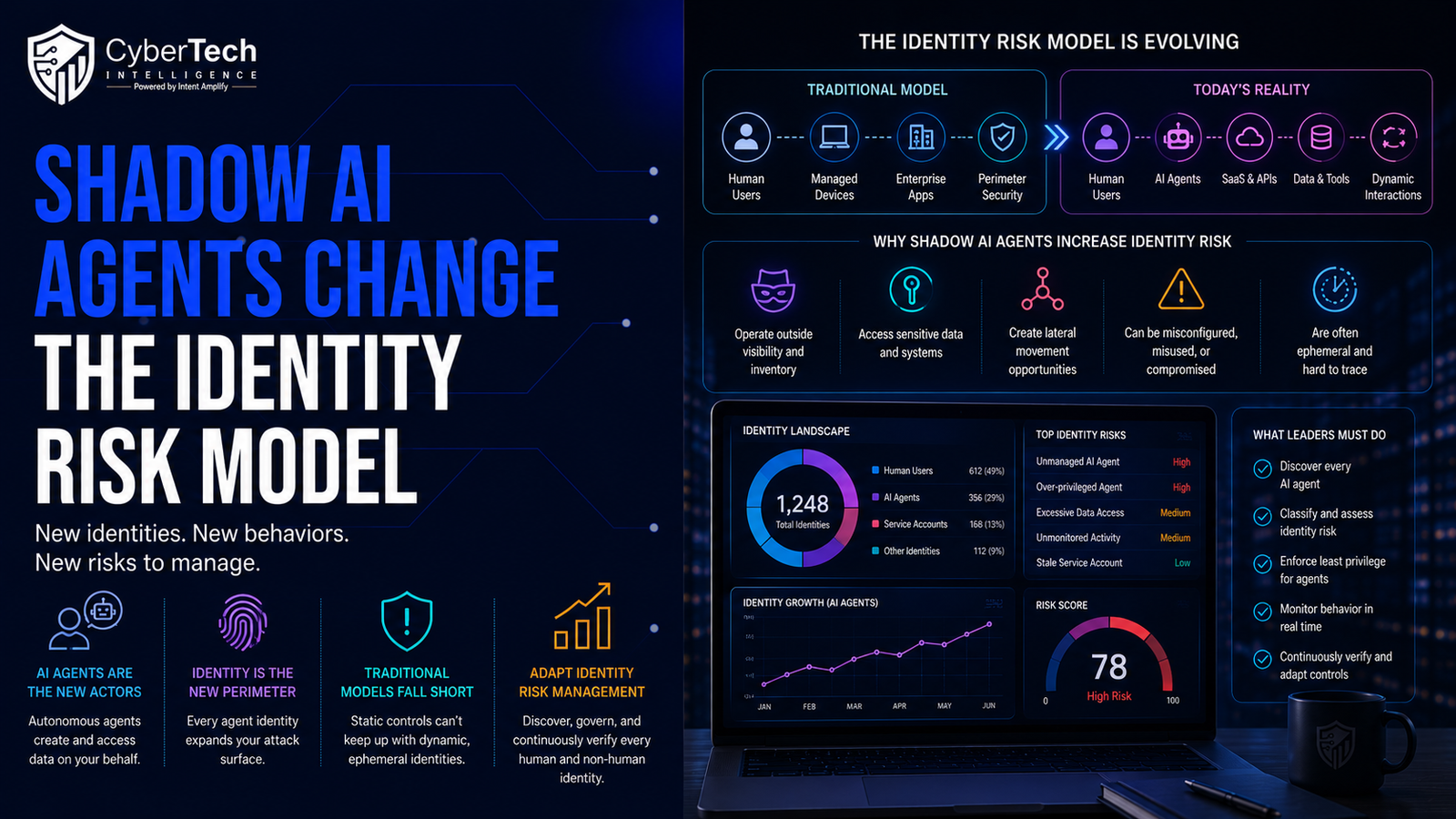
Traditional Identity Controls Assume a More Stable Actor

Identity programs were built around people, applications, service accounts, and workloads whose responsibilities are relatively predictable. AI agents complicate that model because they combine software identity with delegated human intent and a degree of autonomy. Microsoft's current Entra security guidance treats agents as identities that need authentication, authorization, governance, protection, and inventory alongside human and other non-human identities. [1] That is an important shift: the agent is not just a feature inside an application. It can be an actor with its own access decisions and lifecycle.

A Valid Credential Does Not Prove a Valid Action

A traditional access check may correctly confirm that a token is valid and the requested API scope is allowed. That still does not establish that the resulting action matches the original business intent. Google Cloud's 2026 IAM direction emphasizes agent identity, access management, guardrails, and runtime defense as part of the same security model. [2] The reason is structural: agents can process changing inputs, select tools, and take sequences of actions after the original authentication event.

This is where identity risk and agent behavior meet. Security needs to know not only who or what authenticated, but also which authority was granted, how long it persists, and which actions need an independent approval or policy check.

OAuth Makes Task Scope a Governance Question

OAuth is useful because it lets applications and agents obtain delegated access without sharing a user's password. The challenge appears when a broad authorization lives longer than the task that justified it. Netskope's June 2026 analysis argues that agent workflows increase the importance of narrow, task-scoped, time-limited credentials because a compromised or manipulated agent can still make authorized API calls. [4] This is a vendor analysis, but the control principle is consistent with least-privilege practice: access should reflect the task, not the maximum authority of the person who created the workflow.

Agent Identity and Human Accountability Must Coexist

Palo Alto Networks' July 2026 identity-security analysis describes autonomous AI agents as machine workloads that require dedicated identities and distinguishes agent identity from delegated authorization such as OAuth. [3] The operating lesson is not to choose between a human owner and an agent identity. Use both. A dedicated agent identity supports attribution and control; a human sponsor preserves business accountability for why the access exists.

Discovery Is the Control Plane for Shadow AI

An unmanaged agent becomes harder to govern when it is visible only inside a team's tool or browser. The organization then has fragmented evidence: identity knows about a token, endpoint sees a process, SaaS sees an integration, cloud sees an API call, and the business knows the purpose. A useful control plane correlates those facts so the agent can be reviewed as one business actor rather than as unrelated technical events.

Agentic Security Incidents Reinforce the Need for Boundaries

OWASP's Q1 2026 exploit roundup maps reported incidents and disclosures to agentic risks including identity and privilege abuse, tool misuse, human-agent trust exploitation, and rogue-agent behavior. [5] The report is not an incidence-rate study and should not be used to predict that a specific organization will experience the same events. Its value is architectural: when agents can influence permissions, execute tools, or act on live data, boundaries and review gates matter even when the underlying credentials are legitimate.

Machine-Speed Activity Changes the Review Cadence

Periodic access reviews remain useful, but agent workflows can change faster than a quarterly or annual certification cycle. New tools may be connected in a day, tokens can be granted during troubleshooting, and an experimental workflow can become production-like without a formal launch event. Identity governance therefore benefits from event-driven review triggers: a new connector, a scope increase, a sponsor change, new write authority, privileged resource access, or an unusual execution pattern should prompt a fresh control decision.

Identity Telemetry Needs Business Context

Security tooling can observe authentication and access events, but those events are difficult to judge without knowing the task the agent is supposed to perform. A valid API call may be appropriate in one workflow and unnecessary in another. The strongest operating model keeps the business purpose close to the technical telemetry so exceptions can be judged against intent instead of against a static list of allowed products.

The Control Goal Is Explainable Authority

The objective is not perfect predictability. Agentic systems can behave in ways that are harder to enumerate than traditional scripts. The practical control target is explainable authority: the organization can show why the agent exists, which identity acts, what resources are reachable, which actions are permitted, what requires approval, how activity is observed, and how access can be ended. That makes residual risk visible enough for an accountable business decision.

CyberTech Intelligence Perspective

The identity program for agentic AI should answer three questions continuously. First, visibility: which agents and credential paths exist? Second, authority: what can each agent read, change, send, approve, or trigger? Third, accountability: who owns the purpose and who can revoke or redesign the access? If any of those answers are missing, the agent is not ready for broad autonomy.

Strategic Recommendations

  • Treat agent identity as a lifecycle object, not a one-time integration detail.
  • Link every material agent to a human sponsor and a written business purpose.
  • Prefer distinct, task-appropriate credentials over shared or inherited high-privilege access.
  • Review OAuth scopes, service accounts, roles, API keys, and tool permissions for drift after every meaningful workflow change.
  • Require independent approval or deterministic policy for destructive, external, financial, privileged, or production-changing actions.
  • Correlate identity, endpoint, SaaS, cloud, application, and network evidence so shadow agents can be moved into a governed inventory.
  • Measure the time from discovery to control decision and the age of unresolved ownership or permission exceptions.

Identity-Control Governance Matrix

Figure 1. CyberTech Intelligence Identity-Control Governance Matrix for Shadow AI Agents

Decision Stage

Accountable Owner

Required Evidence

Exit Criteria

Discover

Security / IT

Agent location, platform, workflow, observed activity, and identity clue.

Agent is recorded and triaged.

Own

Business / Technology Sponsor

Purpose, human sponsor, expected duration, and responsible team.

Accountability is explicit.

Authorize

Identity / Security

Credential type, scope, resources, tools, data, and high-impact actions.

Access matches the intended task.

Operate

Platform / Application Owner

Approval gates, runtime policy, logging, alerts, and exception path.

Material actions are governable and observable.

Review

Identity Governance / Risk

Current use, owner, access changes, drift, incidents, and expiry.

Continue, constrain, redesign, or retire decision is evidenced.


Bring Shadow AI Identity Into the Executive Risk Review

Use the governance matrix to align Security, Identity, IT, Engineering, Data, and business leaders on one shared question: which software actors currently have authority in the enterprise, and which controls justify keeping that authority? 

About CyberTech Intelligence

CyberTech Intelligence provides research-led cybersecurity intelligence, executive content, and market engagement programs. This publication is vendor-neutral and intended for education, decision support, and claim-safe GTM planning.

Evidence and Citation Note

External sources are used only within their stated scope. Government and standards material supports risk-management and control context; vendor material supports the publisher's own product, research, or operating-model statements. CyberTech Intelligence does not infer that a named organization has a shadow AI agent, an identity weakness, a current incident, a specific product need, or buying intent unless direct evidence establishes that fact.

References

[1] Microsoft Learn, “Microsoft Entra security for AI overview,” Updated 2026. https://learn.microsoft.com/en-us/entra/agent-id/security-for-ai-overview Accessed August 26, 2026. Relevance: Current Microsoft guidance on identity-based security, governance, protection, and inventory for human and non-human identities, including AI agents.

[2] Google Cloud, “What's new in IAM: Security, governance, and runtime defense,” May 6, 2026. https://cloud.google.com/blog/products/identity-security/whats-new-in-iam-security-governance-and-runtime-defense Accessed August 26, 2026. Relevance: Google Cloud perspective on agent identity, access management, guardrails, and runtime defense for agentic workloads.

[3] Palo Alto Networks, “Why Cryptographically Verifiable SPIFFE Identity is Key to Scaling AI Agents,” July 20, 2026. https://www.paloaltonetworks.com/blog/identity-security/ai-agent-security-spiffe-machine-identity/ Accessed August 27, 2026. Relevance: Vendor analysis used only for its distinction between dedicated agent workload identity and delegated authorization, including short-lived identity and auditability considerations.

[4] Netskope, “AI Agents and the OAuth Trust Problem at Scale,” June 11, 2026. https://www.netskope.com/blog/ai-agents-and-the-oauth-trust-problem-at-scale Accessed August 26, 2026. Relevance: Vendor threat analysis used for its discussion of durable OAuth authorization, task scope, and confused-deputy risk in agent workflows.

[5] OWASP Gen AI Security Project, “OWASP GenAI Exploit Round-up Report Q1 2026,” April 14, 2026. https://genai.owasp.org/2026/04/14/owasp-genai-exploit-round-up-report-q1-2026/ Accessed August 26, 2026. Relevance: OWASP incident roundup used only for the reported 2026 exploit patterns mapped to agent identity, privilege, tool-use, and human-agent trust risks.