
Executive Summary
Post-quantum cryptography has moved from long-range cyber planning into a measurable organizational readiness challenge. For United States enterprises, the issue now spans federal mandates, supplier evidence, PKI modernization, CBOM readiness, long-retention data, cloud key management, software signing, identity systems, and board-level accountability.
On June 22, 2026, President Donald J. Trump signed Executive Order 14412, Securing the Nation Against Advanced Cryptographic Attacks. The order warns that large-scale advanced computing capability, especially in adversarial hands, will threaten widely used cryptographic security systems. It also identifies the Harvest Now, Decrypt Later risk, where adversaries collect United States information now for later decryption once large-scale systems become operational.1
The order establishes a firm federal transition timeline: agencies must migrate high-value and high-impact systems to PQC for key establishment by December 31, 2030, followed by digital signatures by December 31, 2031. It also requires migration leadership, OMB guidance, and a NIST pilot, making PQC readiness a measurable governance priority.1
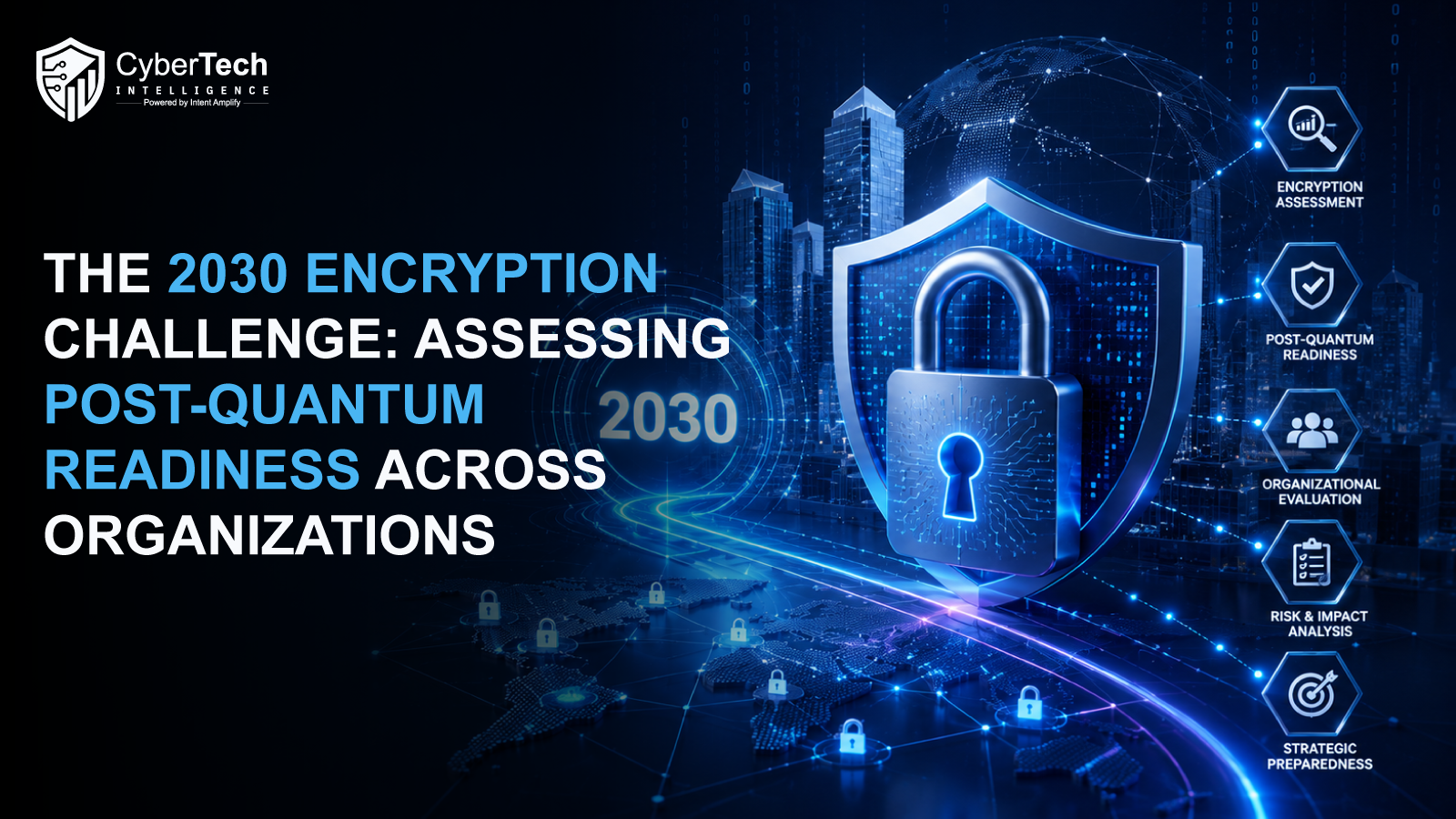
This research report assesses PQC readiness through a 2030 lens and finds that readiness is not a single technology project. It is an enterprise capability built across cryptographic visibility, data longevity mapping, PKI modernization, supplier accountability, crypto agility, and executive evidence.
Organizations waiting until 2029 to begin discovery will likely face compressed timelines, incomplete inventories, vendor bottlenecks, certificate disruption, contract pressure, plus weaker customer confidence. The 2030 encryption challenge has already started.
CyberTech Intelligence Perspective
Enterprise quantum maturity begins with demonstrable visibility into cryptographic assets, system dependencies, third-party cryptographic exposure, and long-lived data risk. Post-quantum readiness should not be treated as a narrow encryption replacement program. It is an enterprise governance discipline that connects crypto agility, supplier assurance, PKI modernization, executive evidence, procurement readiness, and business resilience.
CyberTech Intelligence research and analysis indicates that organizations will be judged less by whether they have tested one post-quantum algorithm and more by whether they can prove where quantum-vulnerable cryptography exists, which records require protection beyond 2030, which suppliers control migration timelines, and how leadership governs progress through measurable evidence.
Methodology and Research Lens
This report uses a primary-source research approach, drawing from federal directives, standards bodies, technology providers, cybersecurity vendors, cloud infrastructure providers, and enterprise security guidance published within the required September 2025 to June 2026 window.
The research lens differs from a conventional migration checklist. Instead of asking only whether a company has started adopting new algorithms, the report evaluates whether leaders can identify vulnerable cryptography, prioritize long-lived data, validate supplier plans, modernize PKI, test future-ready encryption, and report progress through evidence.
CyberTech Intelligence assessment: Quantum readiness will be measured by organizations that can demonstrate disciplined preparation, supplier-backed evidence, operational maturity, and executive visibility.
Finding 1: 2030 Has Become a Compliance Boundary
The 2030 deadline is the defining signal in this market shift. Before the June 2026 order, many organizations treated PQC as a future security program with unclear urgency. The federal timeline now creates a practical boundary for agencies, high-value public-sector systems, high-impact environments, plus covered contractors.
The order directs the Federal Acquisition Regulatory Council to publish a proposed rule within 180 days to amend the Federal Acquisition Regulation. The proposed rule is intended to require covered contractors to comply by December 31, 2030, with NIST Federal Information Processing Standards, including applicable FIPS incorporating PQC-compliant algorithms.1
This clause changes the commercial posture. For vendors serving federal agencies, defense programs, critical infrastructure, public-sector cloud, software platforms, managed services, identity products, security tools, or data services, PQC readiness becomes a market-access issue. It can influence contract eligibility, renewal discussions, procurement scoring, risk reviews, plus customer security questionnaires.
The companion Executive Order 14413, Ushering in the Next Frontier of Quantum Innovation, broadens the national strategy by directing an updated national plan within 180 days. It also establishes the Quantum Computer for Application Development and Discovery Science effort, with system specifications due within 90 days.2
The United States is accelerating advanced computing leadership while also requiring a defensive cryptographic transition. Enterprises cannot treat those tracks separately. Capability development increases strategic importance, while defensive migration reduces long-term exposure.
Executive implication: Boards should ask whether federal timelines affect the company directly through contracts, indirectly through customer expectations, or commercially through supplier assurance requirements.
Finding 2: Readiness Remains Early Despite Rising Executive Awareness
Awareness has increased, but organizational maturity remains limited. IBM’s Secure the Post-Quantum Future reported an average quantum-safe readiness score of 25 on a 100-point scale in 2025, up from 21 in 2023.3
The improvement shows that leadership teams are beginning to respond. The low score, however, signals incomplete execution. Many enterprises still lack a cryptographic inventory, risk-tiered migration roadmap, certificate modernization plan, supplier review process, pilot strategy, exception governance, or board-ready evidence model.
IBM also stated in Quantum Computers Are Speeding Towards Cryptographic Relevancy that Harvest Now, Decrypt Later activity already places currently protected information at future risk.4
This risk is difficult because the breach timeline can separate from the harm timeline. Sensitive encrypted material may be captured years before exposure becomes readable. A legal archive, health record, identity store, aerospace design, government-related file, payment history, product blueprint, or source-code repository can remain valuable into the 2030s.
NIST has finalized three post-quantum cryptography standards and recommends that organizations begin implementation before cryptographically relevant quantum systems threaten current public-key encryption.⁵
Readiness now depends less on standards availability than on whether enterprises can manage cryptographic dependencies as a unified operating capability.
Finding 3: Federal Policy Is Turning PQC Into a Supplier Requirement
The June 2026 mandate introduces an evidence expectation. Agencies must appoint migration leads, OMB must issue guidance, NIST must pilot standards-based adoption, CISA must support migration planning, sector risk management agencies must assist critical infrastructure owners, NSA must report annually on National Security Systems, plus contractors face future FAR-aligned compliance obligations.1
One provision deserves special attention: CISA, in coordination with NIST, must release public guidance within 270 days describing minimum elements for a cryptographic bill of materials.1
A cryptographic bill of materials, or CBOM, could become a decisive artifact in supplier reviews. A software bill of materials identifies components. A CBOM can expose algorithms, libraries, protocols, certificates, modules, key exchange methods, signature schemes, plus dependency chains. For buyers, this shifts vendor assessment from broad assurance to verifiable detail.
CyberTech Intelligence observation: Supplier readiness will likely become one of the largest blockers before 2030. Internal teams may build strong plans, yet a critical SaaS provider, firewall platform, identity vendor, certificate authority, operational technology supplier, or software vendor may lack clear support. Procurement teams need to move earlier than they normally would.
Vendor questionnaires should ask which products use RSA, ECC, ECDH, ECDSA, or classical Diffie-Hellman; which NIST standards will be supported; whether hybrid operation is available; which versions include PQC support; how certificate size or signature changes affect performance; whether upgrade costs apply; and how customer evidence will be provided.
Executive implication: PQC readiness should enter renewal cycles now. Waiting until contracts expire near 2030 will reduce negotiating leverage.
Finding 4: Cryptographic Visibility Is the First Readiness Gap
Most organizations cannot migrate what they cannot locate. Cryptographic visibility is the foundation of post-classical preparedness.
NIST’s crypto-agility project highlights the need to replace cryptographic algorithms as computing advances, cryptanalysis develops, or standards change.6
Crypto agility depends on knowing what exists. Security teams need to identify public-key usage across Transport Layer Security, Secure Shell, virtual private networks, internal certificates, public certificates, code signing, service identity, API authentication, key stores, cloud KMS usage, hardware security modules, application libraries, backup platforms, endpoint software, database encryption, plus third-party integrations.
Cloudflare reported in April 2026 that post-quantum encryption for Cloudflare IPsec was generally available. It also stated that more than two-thirds of human-generated TLS traffic to Cloudflare was already protected by post-quantum cryptography. 7
That progress shows that internet-scale infrastructure can move quickly under centralized control. Enterprise estates are more fragmented. A large business may operate multiple certificate authorities, unmanaged internal services, older VPN appliances, regional cloud accounts, manual certificate renewal processes, inherited applications, decentralized DevOps pipelines, plus vendor-hosted records. Each area can contain hidden exposure.
Google Cloud’s ML-KEM capabilities in Cloud KMS preview show how cloud pilots can support early experimentation, but they do not replace full cryptographic inventory across enterprise systems.8
Research finding: Organizations with automated certificate management, mature asset inventories, disciplined third-party risk programs, centralized key governance, plus active architecture review boards will move faster than those relying on manual documentation.
Finding 5: Sector Exposure Varies by Data Lifespan and Infrastructure Complexity
PQC readiness will not advance evenly across sectors. Exposure depends on how long records remain sensitive, how complex the technology estate is, how heavily operations rely on suppliers, plus how closely the organization connects to federal or regulated markets.
Financial services face high exposure because payment rails, customer authentication, mobile banking, transaction archives, trading platforms, settlement processes, digital signatures, open banking APIs, hardware security modules, plus interbank messaging depend heavily on public-key methods. A short-lived credential may lose value quickly. A transaction archive, client profile, or cross-border settlement record may remain sensitive for years.
Healthcare has a different exposure profile. Patient files, genomic data, insurance claims, medical imaging, diagnostic records, clinical research, identity data, telehealth platforms, plus connected medical devices can retain value for decades. Many providers also depend on vendor-heavy ecosystems where software platforms, device manufacturers, clearinghouses, cloud vendors, plus data exchanges control part of the transition path.
Government contractors now face direct 2030 pressure because the federal order instructs acquisition rulemaking for covered contractor compliance by December 31, 2030.1
Critical infrastructure operators face operational constraints. Energy, telecommunications, water, transportation, utilities, manufacturing, plus industrial environments often operate long-lifecycle systems. Many operational technology assets were not designed for frequent cryptographic change. The federal order directs Sector Risk Management Agencies to work with CISA in assisting critical infrastructure owners plus operators with migration plans.1
Network security teams will also face product-cycle dependencies. Cisco’s Secure Firewall roadmap states that ML-KEM support for Secure Firewall Threat Defense 10.5 plus ASA 9.25 is targeted for general availability in late 2026.9
Sector implication: High-exposure industries should treat quantum readiness as an immediate governance priority. Early inventories, targeted pilots, supplier pressure, executive funding, and exception tracking are now baseline requirements for credible transition planning.
CyberTech Intelligence Research Desk Observation: Organizations are unlikely to fail post-quantum migration because algorithms are unavailable. They are more likely to encounter delays because cryptographic inventories are incomplete, supplier dependencies are unclear, PKI environments are fragmented, and governance ownership is weak. Organizations that establish visibility early will retain greater operational flexibility as federal timelines, procurement requirements, customer assurance expectations, and supplier roadmaps accelerate toward 2030.
CyberTech Intelligence Enterprise PQC Readiness Framework
The CyberTech Intelligence Enterprise PQC Readiness Framework gives security and executive teams a proprietary model for assessing post-quantum readiness across six core dimensions: Cryptographic Visibility, Data Longevity Prioritization, Crypto Agility, Supplier Assurance, PKI Modernization, and Executive Governance.
Level 1 – Awareness: Leadership understands PQC at a conceptual level. No complete inventory exists. Supplier questions are ad hoc. PKI exposure is not fully mapped. Readiness is discussed, not operationalized.
Level 2 – Discovery: Security teams begin mapping algorithms, certificates, keys, libraries, protocols, cloud services, network devices, application dependencies, plus supplier-managed cryptography. Long-retention records are identified. Ownership becomes clearer.
Level 3 – Prioritized Planning: High-value systems are ranked by confidentiality horizon, business criticality, regulatory exposure, supplier dependency, and upgrade difficulty. Procurement begins using PQC language. Board reporting starts.
Level 4 – Controlled Execution: Hybrid pilots are active. Cloud KMS experiments, VPN lab tests, certificate automation, software signing trials, supplier evidence reviews, plus limited production deployments produce measurable learning.
Level 5 – Assured Transition: High-value systems follow documented migration plans. Supplier contracts contain enforceable requirements. CBOM-style evidence is available. PKI is automated. Exceptions have owners, dates, and funding paths. Executives receive clear metrics.
A practical executive readiness dashboard should include CBOM maturity, percentage of quantum-vulnerable assets identified, high-value assets assessed, long-retention repositories mapped, supplier readiness coverage, certificate automation maturity, crypto agility maturity, pilot outcomes, unresolved blockers, exception aging, funding gaps, and executive reporting cadence. These indicators help boards distinguish real transition progress from general awareness.
Strategic Actions for Security Leaders
First, appoint a transition owner. Federal agencies are required to name migration leads within 30 days; private enterprises should adopt the same discipline.1
Second, build a cryptographic inventory. Include algorithms, certificates, keys, libraries, protocols, service identities, code-signing workflows, cloud encryption, VPNs, embedded devices, application dependencies, plus supplier platforms.
Third, rank information by confidentiality horizon. The most urgent records are those that remain sensitive beyond 2030. These include health records, legal archives, financial histories, product designs, government-related files, privileged identity stores, regulated repositories, plus proprietary research.
Fourth, modernize PKI. Microsoft Learn describes post-quantum cryptography support in Active Directory Certificate Services involving ML-DSA, underscoring certificate infrastructure as a transition workstream.10
Fifth, test in controlled environments. Cloud KMS pilots, VPN labs, noncritical TLS services, certificate automation proofs, code-signing trials, plus development sandboxes can reduce uncertainty before production adoption.
Sixth, pressure suppliers early through contract language covering standards support, version timelines, hybrid capability, certificate impact, performance evidence, and migration support.
Seventh, report to the board using operational metrics. Avoid abstract updates. Leaders need inventory coverage, high-risk assets mapped, supplier commitments received, pilots completed, CBOM readiness, exception status, and funding gaps.
IBM’s June 2026 announcement described IBM Quantum Starling as a fault-tolerant system expected in 2029, designed to execute 20,000 times more operations than today’s systems. IBM also said Starling would lay the groundwork for IBM Quantum Blue Jay, expected to run 1 billion operations across 2,000 qubits.11
Such milestones should drive disciplined preparation, not reactive panic.
Conclusion
The 2030 encryption challenge is no longer theoretical. Federal policy has created firm timelines. Standards are available. Major technology providers are publishing roadmaps. Cloud capabilities are entering preview. Network vendors are planning support. Contractors will face compliance requirements. Critical infrastructure operators will receive migration expectations. Customers will ask for proof.
The organizations best positioned for the next phase will be those that move from awareness to evidence. They will know where cryptographic exposure exists. They will understand which records require long-term protection. They will test PQC in controlled settings. They will modernize PKI. They will hold suppliers accountable. They will report progress to executives using measurable indicators.
This is not only a security program. It is a trust-preservation exercise for the next decade of digital business.
By 2030, post-quantum readiness will likely become a baseline indicator of cyber maturity. Organizations that begin now will transform post-quantum migration into a structured resilience program. Those that delay risk compressed implementation timelines, supplier constraints, regulatory pressure, and operational disruption.
Enterprise Post-Quantum Readiness Assessment
Post-quantum readiness now requires more than awareness of standards or isolated cryptographic pilots. It requires evidence that the enterprise can identify quantum-vulnerable assets, build crypto agility, assess CBOM maturity, modernize PKI, validate supplier readiness, govern cloud cryptography, and report progress to executive stakeholders.
CyberTech Intelligence helps CISOs, CIOs, CTOs, enterprise architects, infrastructure leaders, procurement teams, risk leaders, and board stakeholders evaluate these capabilities through an Enterprise Post-Quantum Readiness Assessment. The assessment examines cryptographic inventories, crypto agility, CBOM maturity, PKI modernization, supplier readiness, cloud cryptography, and executive governance.
For organizations preparing for the 2030 encryption challenge, this assessment can support board reporting, procurement readiness, supplier assurance, PKI modernization, and post-quantum migration planning.
Contact CyberTech Intelligence
References
- The White House / Federal Register, Securing the Nation Against Advanced Cryptographic Attacks, June 22, 2026
https://www.federalregister.gov/documents/2026/06/25/2026-12909/securing-the-nation-against-advanced-cryptographic-attacks - The White House / Federal Register, Ushering in the Next Frontier of Quantum Innovation, June 22, 2026
https://www.federalregister.gov/documents/2026/06/25/2026-12910/ushering-in-the-next-frontier-of-quantum-innovation - IBM Institute for Business Value, Secure the Post-Quantum Future, October 2025
https://www.ibm.com/thought-leadership/institute-business-value/en-us/report/2025-quantum-safe-readiness - IBM, Quantum Computers Are Speeding Towards Cryptographic Relevancy, April 2026
https://www.ibm.com/think/perspectives/quantum-computers-are-speeding-towards-cryptographic-relevancy - National Institute of Standards and Technology, Post-Quantum Cryptography, 2026
https://www.nist.gov/pqc - National Institute of Standards and Technology, Crypto Agility, 2026
https://csrc.nist.gov/projects/crypto-agility - Cloudflare, Post-Quantum Encryption for Cloudflare IPsec Is Generally Available, April 2026
https://blog.cloudflare.com/post-quantum-ipsec/ - Google Cloud, How We’re Helping Customers Prepare for a Quantum-Safe Future, 2025
https://cloud.google.com/blog/products/identity-security/how-were-helping-customers-prepare-for-a-quantum-safe-future - Cisco, Preparing for Post-Quantum Cryptography: The Secure Firewall Roadmap, April 2026
https://blogs.cisco.com/security/preparing-for-post-quantum-cryptography-the-secure-firewall-roadmap - Microsoft Learn, Post-Quantum Cryptography in Active Directory Certificate Services Overview, 2026
https://learn.microsoft.com/en-us/windows-server/identity/ad-cs/post-quantum-cryptography-overview - IBM Newsroom, IBM Commits More Than $10 Billion to Quantum Computing, Funding Its Roadmap From Today’s Leading Systems to the World’s First Fault-Tolerant Quantum Computers, June 2, 2026
https://newsroom.ibm.com/2026-06-02-ibm-commits-more-than-10-billion-to-quantum-computing,-funding-its-roadmap-from-todays-leading-systems-to-the-worlds-first-fault-tolerant-quantum-computers