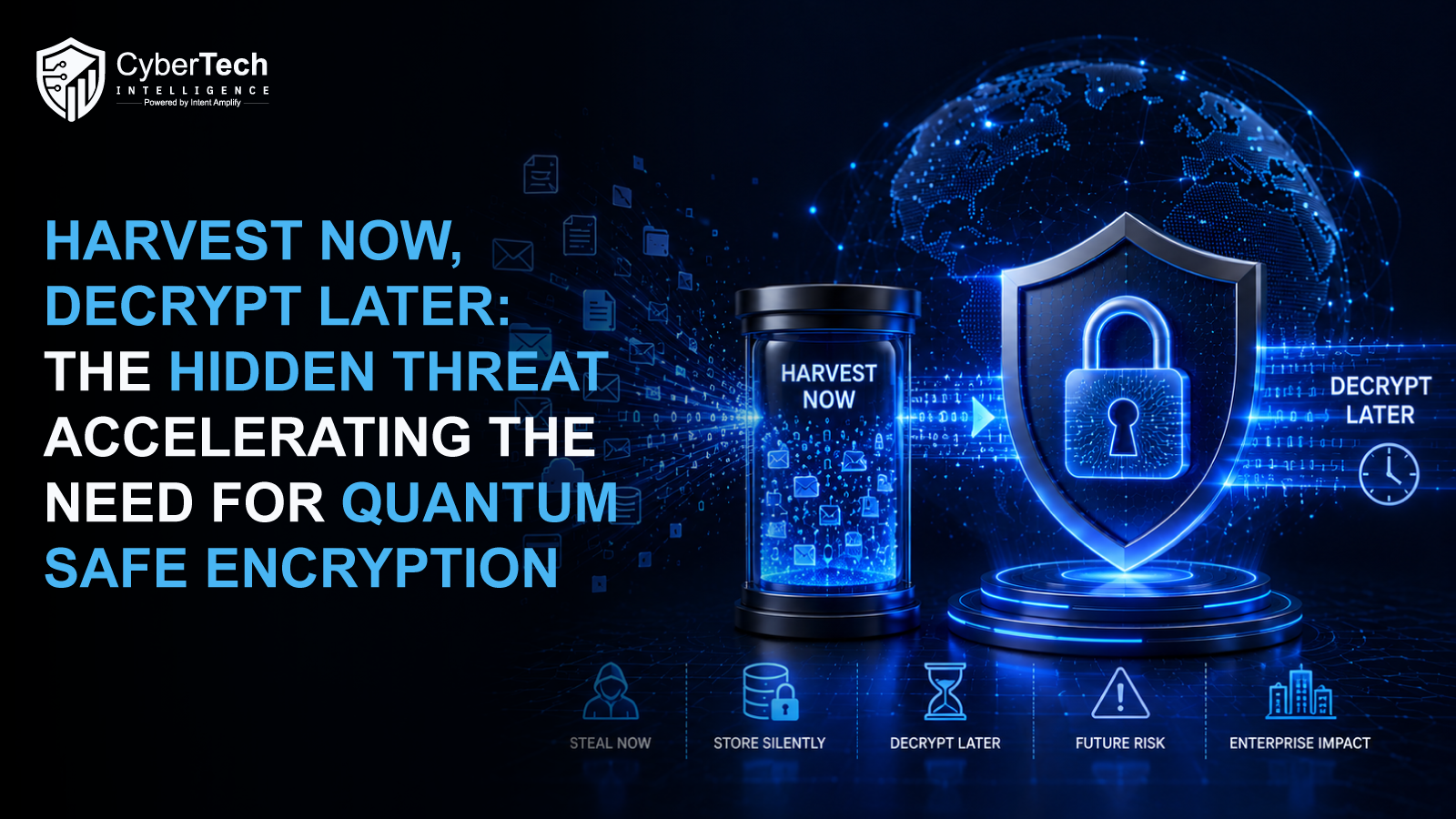
A breach does not always finish when an attacker leaves the network. In the post-quantum era, the more damaging part may arrive years later.
Harvest Now, Decrypt Later operates on an uncomfortable premise: encrypted information stolen today may become readable years later when advanced decryption capabilities mature. Adversaries can collect encrypted information today, preserve it quietly, and wait for future quantum capabilities to weaken the cryptography protecting those records. For United States enterprise leaders, this shifts quantum risk from a distant science problem into a present data protection concern.
The central issue is not whether a cryptographically relevant quantum computer is available at scale this quarter. It is whether confidential information stolen today will still matter when future decryption becomes possible. IBM warned in Quantum Computers Are Speeding Towards Cryptographic Relevancy that fault-tolerant quantum computers could begin approaching cryptographic relevance by the end of this decade, while Harvest Now, Decrypt Later attacks already place currently protected information at risk.1
This is why quantum-safe encryption is no longer a narrow cryptography discussion. It is becoming a test of leadership, discipline, data stewardship, business continuity, and digital trust.
CyberTech Intelligence Perspective
Harvest Now, Decrypt Later fundamentally changes how organizations should classify enterprise information. The priority is no longer only current business value, current system usage, or current regulatory status. Leaders must also assess how long confidentiality must be preserved.
CyberTech Intelligence research and analysis indicates that long-life data should become a primary driver of post-quantum readiness. Patient records, legal material, payment histories, proprietary research, identity data, software-signing assets, executive communications, and strategic archives may remain sensitive long after an incident is closed. In that environment, quantum-safe encryption becomes a governance issue because today’s encrypted data may become tomorrow’s exposed business risk.
The Breach Afterlife: When Encrypted Data Still Creates Future Exposure
Most security programs measure breaches through immediate impact: stolen credentials, business interruption, ransomware loss, regulatory notification, customer churn, or incident response cost. Harvest Now, Decrypt Later adds another dimension. It creates a breach afterlife.
A financial archive, legal negotiation file, defense-related design, medical record, insurance dataset, executive communication, source-code repository, or merger document may retain sensitivity long after the original incident is closed. Encryption may keep it unreadable today, yet current public-key systems were not designed for future quantum adversaries.
This classification gap matters because many organizations evaluate information by current business use, not by how long it must remain confidential. A database may look inactive. A backup set may appear low priority. An old legal archive may sit outside active security modernization. Yet those assets can carry long-tail exposure if they contain regulated, strategic, personal, or proprietary material.
IBM’s Secure the Post-Quantum Future notes that quantum computers capable of breaking today’s encryption may emerge five to six years before many organizations complete their transition, while threat actors are already using Harvest Now, Decrypt Later tactics.2
IBM’s readiness finding reframes the urgency around quantum-safe planning. The risk clock is not set by quantum hardware alone. It is also set by how long sensitive information must remain confidential and how slowly large organizations can change cryptographic foundations.
Why the Enterprise Timeline Is Shorter Than It Looks
Post-Quantum Cryptography is often discussed through standards, algorithms, and technical roadmaps. Executives need a different lens: transition capacity.
Cryptography is buried inside identity systems, Transport Layer Security, application programming interfaces, virtual private networks, public key infrastructure, payment platforms, software signing workflows, cloud key management, hardware security modules, connected devices, developer libraries, and supplier-managed applications. In many environments, no single team owns the full map.
This fragmented cryptographic footprint makes quantum readiness difficult for large enterprises. A company cannot protect long-life information if it cannot locate the algorithms, certificates, keys, libraries, and services guarding it. Nor can it negotiate supplier accountability if procurement lacks precise questions about quantum-resistant encryption, hybrid deployment, certificate support, and migration timing.
Google introduced a 2029 timeline for post-quantum cryptography migration, citing progress in quantum hardware development, quantum error correction, and quantum factoring resource estimates.3
Cloudflare also moved its target for full post-quantum security to 2029, including post-quantum authentication, after stating that recent advances in quantum hardware and software had accelerated potential attack timelines.4
These signals matter because enterprise security programs do not move in isolation. Browser vendors, cloud platforms, certificate authorities, firewall providers, identity systems, endpoint platforms, and SaaS suppliers shape how quickly private organizations can migrate. When major infrastructure providers begin publishing accelerated post-quantum roadmaps, enterprise planning windows shrink.
The Standards Trigger: From Awareness to Executable Planning
For years, leaders could reasonably argue that quantum-safe migration was premature because standards were still maturing. The argument for waiting has weakened as post-quantum standards, vendor roadmaps, and infrastructure timelines have become more concrete.
NIST states that three post-quantum encryption standards are ready for implementation and identifies this as the time to migrate before quantum computers place current encryption at risk.5
Those standards matter for two reasons. First, they give architects a stable reference for evaluating future-ready encryption. Second, they give boards, auditors, and customers a basis for asking whether organizations have begun readiness planning.
The standards moment does not mean every workload should be re-engineered immediately. A rushed rollout can create outages, incompatibility, performance issues, and support gaps. The smarter response is structured preparation: discover cryptographic dependencies, classify information by confidentiality lifespan, assess supplier roadmaps, pilot hybrid models, and design future systems with crypto agility.
Crypto agility is especially important because the post-quantum transition will not be the last cryptographic shift. Algorithms evolve. Implementations mature. Compliance requirements change. New weaknesses appear. Organizations able to replace cryptographic components without destabilizing operations will be better positioned for each future cycle.
Why Data Longevity Should Drive Prioritization
Not every dataset deserves equal urgency. The most exposed assets are those with long-term value.
A short-lived marketing file does not carry the same future risk as patient records, payment infrastructure metadata, identity attributes, legal material, national-security-adjacent information, product blueprints, or proprietary research. Harvest Now, Decrypt Later shifts prioritization toward information that could still create financial, regulatory, reputational, or strategic harm if exposed in 2030 or later.
This future-impact lens changes how security leaders should allocate resources. Instead of beginning only with the most visible systems, organizations should prioritize the most durable secrets. Long-retention data, regulated archives, critical communications, privileged identity stores, and intellectual property repositories should receive earlier assessment because their confidentiality value extends beyond normal incident-response timelines.
Microsoft’s June 2026 Windows security update describes quantum safety as a staged transition across customer environments and highlights new platform advances intended to reduce Harvest Now, Decrypt Later risk.6
For executives, the lesson is practical. Quantum-safe encryption should not sit apart from existing modernization work. It should be embedded into data governance, cloud security, identity modernization, Zero Trust architecture, certificate lifecycle management, software supply chain protection, and third-party risk management.
CyberTech Intelligence Research Desk Observation: Organizations that begin classifying information by confidentiality lifespan today will establish a significant governance advantage over organizations that postpone cryptographic discovery until procurement or regulatory pressure accelerates. Long-life data, rather than quantum hardware timelines, should become the primary driver of post-quantum readiness.
The Supplier Problem: Most Boards Underestimate
Large enterprises rarely control every cryptographic decision supporting their business. Encryption may be embedded in a customer portal, managed detection platform, payroll system, claims application, firewall, cloud service, identity provider, analytics environment, or industrial control product.
Supplier-controlled cryptography creates commercial exposure because a vendor’s readiness can directly affect the customer’s migration timeline. A vendor’s post-quantum readiness can become the customer’s migration bottleneck. If a supplier cannot explain which cryptographic algorithms it uses, whether it supports NIST post-quantum standards, when hybrid deployment will be available, or how certificate changes will affect customers, the buyer inherits uncertainty.
Cisco’s Secure Firewall roadmap states that ML-KEM support for Secure Firewall Threat Defense 10.5 and ASA 9.25 is targeted for general availability in late 2026, positioning post-quantum migration as a practical infrastructure planning issue rather than a research topic.7
This type of product roadmap helps security teams plan upgrade cycles, but it also reveals a broader truth. Quantum readiness will arrive unevenly across the enterprise technology stack. Some providers will move quickly. Others will delay because of legacy architecture, performance trade-offs, product complexity, or weak customer demand. Procurement teams need to convert post-quantum questions into contract language, renewal criteria, security questionnaires, and vendor-risk scoring.
CyberTech Intelligence Enterprise Quantum Readiness Framework
The CyberTech Intelligence Enterprise Quantum Readiness Framework™ gives enterprise leaders a practical model for responding to Harvest Now, Decrypt Later risk without creating fragmented pilots or premature deployments. The framework is built around five pillars: Data Longevity, Cryptographic Discovery, Supplier Accountability, Controlled Modernization, and Executive Governance.
|
Framework Pillar |
Executive Question |
Governance Purpose |
|
Data Longevity |
Which information must remain confidential beyond the current business, legal, or operational cycle? |
Prioritizes long-life records that could create future exposure if harvested today and decrypted later |
|
Cryptographic Discovery |
Where are public-key algorithms, certificates, keys, libraries, and cryptographic services used across the enterprise? |
Gives security teams visibility into the systems that require quantum-safe planning |
|
Supplier Accountability |
Which vendors control cryptographic dependencies, upgrade timelines, certificate support, and migration evidence? |
Prevents supplier readiness gaps from becoming enterprise migration bottlenecks |
|
Controlled Modernization |
Where can the organization test quantum-safe encryption without disrupting critical operations? |
Supports pilots across cloud key management, internal TLS, VPN labs, development environments, and controlled services |
|
Executive Governance |
Can leadership track exposure, ownership, sequencing, supplier readiness, investment needs, and measurable progress? |
Turns quantum readiness into a board-visible resilience discipline |
This framework helps organizations move from awareness to operating discipline. Security leaders should begin with long-life data classification, then build cryptographic inventories, pressure suppliers early, test in controlled environments, and report progress through executive-ready evidence.
Executive Quantum Readiness Scorecard
According to CyberTech Intelligence research and analysis, quantum readiness should be measured through governance evidence rather than general awareness. The scorecard below helps CISOs, CIOs, CTOs, enterprise architects, procurement leaders, risk leaders, and board stakeholders assess whether the organization is prepared to manage Harvest Now, Decrypt Later exposure.
|
Readiness Area |
Executive Question |
Evidence to Review |
|
Long-Life Data Classification |
Has the organization identified information that must remain confidential beyond 2030? |
Data longevity maps, regulated archive inventories, legal repository reviews, IP classification, identity data inventories |
|
Cryptographic Inventory Maturity |
Can security teams locate vulnerable public-key cryptography across systems and suppliers? |
Algorithm inventories, certificate maps, key repositories, TLS usage, VPN records, application dependency reviews |
|
Supplier Readiness |
Can critical vendors explain post-quantum support, hybrid deployment, certificate implications, and migration timing? |
Supplier roadmaps, security questionnaires, contract language, NIST standards alignment, upgrade evidence |
|
Crypto Agility |
Can cryptographic components be replaced without major business disruption? |
Certificate lifecycle maturity, algorithm replacement plans, rollback procedures, compatibility testing, exception registers |
|
Executive Reporting |
Can leadership see quantum readiness progress through measurable indicators? |
Board dashboards, exposure metrics, supplier readiness scores, pilot outcomes, funding needs, ownership records |
|
Governance Maturity |
Is post-quantum readiness integrated into enterprise risk, procurement, architecture, and resilience planning? |
Governance charters, architecture review records, procurement criteria, risk registers, resilience roadmap updates |
This scorecard improves board usability by translating HNDL exposure into measurable readiness indicators. It helps leaders identify whether quantum-safe planning is becoming a managed enterprise capability or remaining a technical discussion without governance evidence.
Quantum Safe Encryption Is Becoming a Trust Signal
The market will not wait for one dramatic quantum event. Pressure will arrive through procurement questionnaires, cyber insurance reviews, customer due diligence, regulatory expectations, software updates, certificate changes, and infrastructure roadmaps.
Organizations able to explain their quantum readiness will look more credible to customers and partners. They will show that long-term confidentiality is being governed rather than deferred. They will also gain more control over timing, investment, and operational change.
Those who wait may still migrate, but under tighter conditions. They may discover undocumented cryptography during audits, supplier delays during renewals, application fragility during testing, and executive concern once external stakeholders begin asking sharper questions.
Harvest Now, Decrypt Later is dangerous because it turns time against the defender. Quantum-safe encryption reverses the equation by giving leaders time to map exposure, protect long-life information, modernize trust infrastructure, and build crypto agility before urgency becomes disruption.
For United States enterprises, the strategic message is clear. The quantum threat does not begin when a quantum computer breaks encryption at scale. It begins when today’s sensitive information is collected for tomorrow’s decryption.
Organizations that establish cryptographic visibility, long-life data governance, supplier accountability, and measurable readiness today will not simply prepare for post-quantum cryptography. They will preserve enterprise trust, business resilience, and long-term digital confidence.
Enterprise Quantum Readiness Assessment
Harvest Now, Decrypt Later risk requires more than awareness of post-quantum cryptography. It requires evidence that the enterprise can identify cryptographic exposure, classify long-life data, build crypto agility, validate supplier readiness, govern executive reporting, and measure migration readiness.
CyberTech Intelligence helps CISOs, CIOs, CTOs, enterprise architects, procurement leaders, risk leaders, and board stakeholders evaluate these capabilities through an Enterprise Quantum Readiness Assessment. The assessment examines cryptographic inventory maturity, long-life data exposure, crypto agility, supplier readiness, executive governance, board reporting, and migration readiness.
For organizations strengthening quantum-safe encryption strategies, this assessment can support board education, supplier assurance, data protection planning, crypto-agility roadmaps, and post-quantum migration readiness.
About CyberTech Intelligence
CyberTech Intelligence helps enterprise cybersecurity and technology leaders translate complex security shifts into research-led narratives, buyer-focused insights, and strategic demand programs. Across quantum-safe encryption, post-quantum cryptography, crypto agility, identity security, cloud protection, Zero Trust, SIEM, XDR, and threat intelligence, CyberTech Intelligence supports organizations working to connect emerging cyber risk with executive decision-making.
Contact CyberTech Intelligence
References
-
IBM, Quantum Computers Are Speeding Towards Cryptographic Relevancy, April 2026
https://www.ibm.com/think/perspectives/quantum-computers-are-speeding-towards-cryptographic-relevancy -
IBM Institute for Business Value, Secure the Post-Quantum Future, October 2025
https://www.ibm.com/thought-leadership/institute-business-value/en-us/report/2025-quantum-safe-readiness -
Google, Google’s Timeline for PQC Migration, March 2026
https://blog.google/innovation-and-ai/technology/safety-security/cryptography-migration-timeline/ -
Cloudflare, Cloudflare Targets 2029 for Full Post-Quantum Security, April 2026
https://blog.cloudflare.com/post-quantum-roadmap/ -
NIST, Post-Quantum Cryptography, 2026
https://www.nist.gov/pqc -
Microsoft Security, New Windows Features to Secure Today’s Data in a Post-Quantum World, June 2026
https://techcommunity.microsoft.com/blog/microsoft-security-blog/new-windows-features-to-secure-today%E2%80%99s-data-in-a-post-quantum-world/4523370 -
Cisco, Preparing for Post-Quantum Cryptography: The Secure Firewall Roadmap, April 2026
https://blogs.cisco.com/security/preparing-for-post-quantum-cryptography-the-secure-firewall-roadmap
Author
Yash Lad
Author