

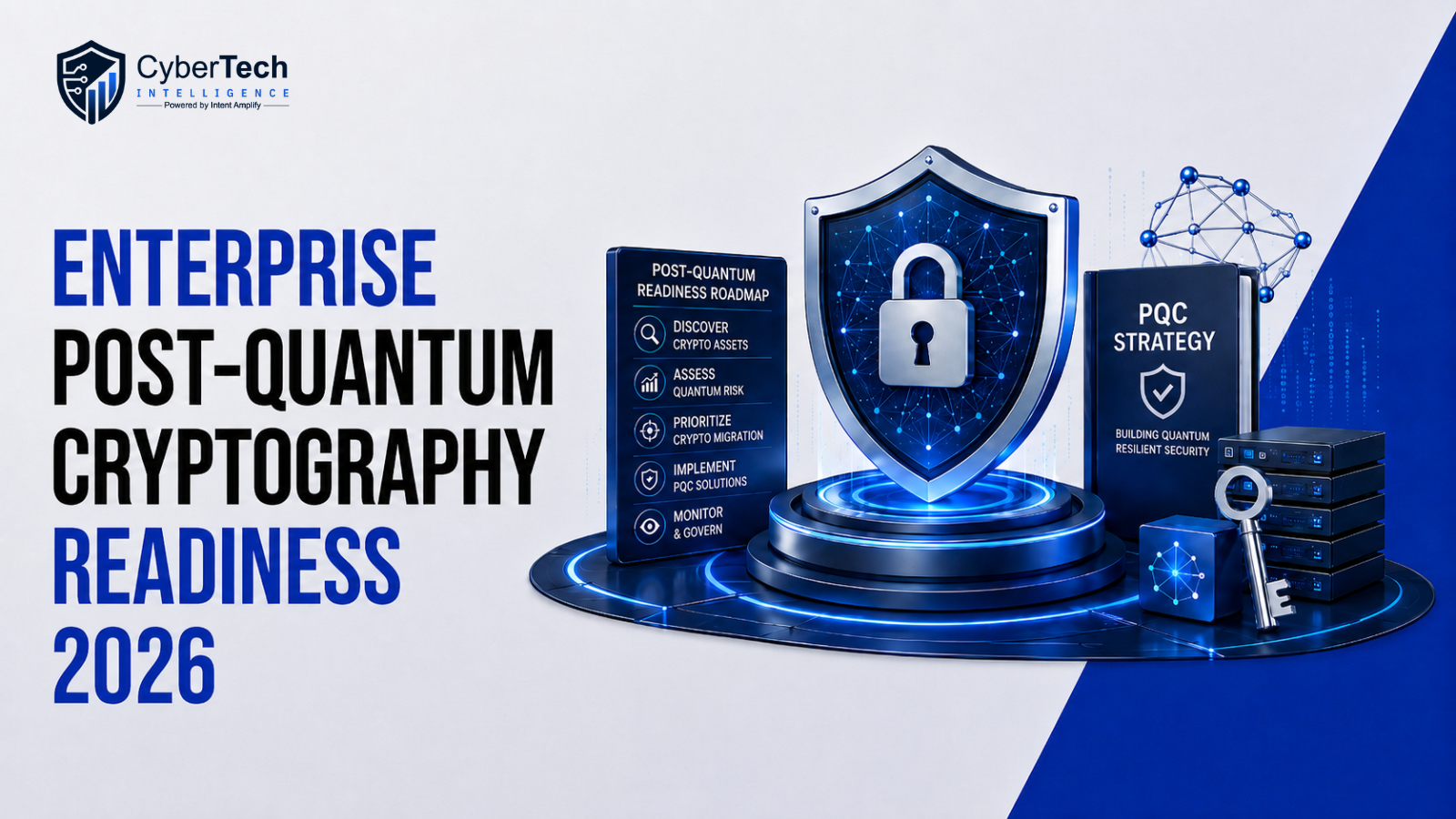
Executive Summary
Post-quantum cryptography (PQC) is transitioning from an emerging research discipline to a strategic enterprise priority. The release of NIST's first finalized post-quantum cryptography standards has accelerated planning activities across both public and private sectors. Organizations responsible for long-lived sensitive information are increasingly evaluating the impact of quantum-resistant cryptographic algorithms on identity systems, public key infrastructure (PKI), cloud environments, software supply chains, and third-party technology ecosystems.
While large-scale cryptographically relevant quantum computers are not yet operational, the enterprise risk landscape is changing today. Security leaders are no longer asking whether they should prepare for post-quantum cryptography, but how they should sequence modernization efforts without disrupting business operations.
This report analyzes the current state of enterprise PQC readiness through five strategic dimensions:
- Market adoption trends
- Technology and standards evolution
- Vendor ecosystem maturity
- Enterprise implementation challenges
- Strategic recommendations for security leaders
Rather than predicting exact timelines for quantum computing, this report focuses on practical organizational readiness. It provides decision-makers with evidence-based insights into where enterprises are investing, which technology domains are evolving most rapidly, and how organizations can build resilient cryptographic governance programs.
CyberTech Intelligence Perspective
Enterprise post-quantum readiness should be evaluated through observable capability signals rather than awareness, vendor announcements, or unsupported claims of preparedness. The most reliable indicators are governance ownership, inventory coverage, PKI and certificate-management maturity, supplier evidence, pilot capacity, business-risk prioritization, and executive reporting. This report interprets current standards, public guidance, vendor roadmaps, and enterprise technology patterns through that capability-based lens.
Research Methodology and Evidence Scope
This report is based on secondary research and CyberTech Intelligence analyst synthesis. The evidence base includes published standards and guidance from NIST, CISA, and NCCoE; publicly available vendor product roadmaps and technical documentation; regulatory and public-sector modernization guidance; and established enterprise architecture, PKI, cloud, software supply-chain, and cryptographic-governance practices. Statements describing market direction or enterprise behavior represent directional analyst assessment unless accompanied by a specific quantitative source. The report does not claim to present original survey findings or statistically representative adoption data.
CyberTech Intelligence Research Desk Observation
The market is moving unevenly. Standards availability does not automatically translate into enterprise implementation readiness, and public vendor support statements do not prove product-level interoperability, lifecycle support, or customer migration capability. Regulated organizations may have stronger incentives to act early, but readiness should be measured through evidence at the system, supplier, and operating-model levels. The decisive signal is not whether an organization has discussed PQC; it is whether it can produce a defensible inventory, prioritized roadmap, accountable governance model, and validated path for controlled change.
Market Overview
The enterprise cybersecurity market has entered a new phase of cryptographic modernization. Regulatory guidance, evolving industry standards, and increased awareness of long-term data protection requirements have encouraged organizations to begin evaluating the implications of post-quantum cryptography.
Unlike previous encryption transitions, PQC affects nearly every component of digital trust, including authentication, certificate management, secure communications, software integrity, cloud infrastructure, and partner connectivity.
As a result, post-quantum readiness is becoming a cross-functional initiative involving security, infrastructure, cloud engineering, application development, procurement, risk management, and executive leadership.
Several factors are driving enterprise interest:
- Publication of NIST PQC standards
- Growing focus on "Harvest Now, Decrypt Later" risks
- Increased investment in cryptographic agility
- Modernization of enterprise PKI
- Expansion of Zero Trust initiatives
- Cloud-native security transformation
- Greater scrutiny of third-party technology resilience
Organizations are increasingly viewing PQC as part of broader digital trust and cyber resilience strategies rather than an isolated cryptographic upgrade.
Enterprise Adoption Trends
Enterprise adoption remains in the early stages, but planning activity has increased significantly.
Most organizations are not deploying post-quantum algorithms across production environments. Instead, they are focusing on foundational readiness activities that reduce uncertainty and improve long-term planning.
Common initiatives include:
- Enterprise cryptographic inventories
- PKI modernization projects
- Certificate lifecycle automation
- Crypto-agility assessments
- Vendor roadmap evaluations
- Pilot testing in non-production environments
- Integration of PQC requirements into procurement processes
Highly regulated industries including financial services, healthcare, government, defense, and critical infrastructure are generally moving more quickly due to long-term confidentiality requirements and regulatory obligations.
Organizations with mature Zero Trust programs and cloud modernization initiatives are also better positioned to incorporate PQC planning into existing transformation efforts.
Standards and Regulatory Landscape
The publication of NIST FIPS 203, FIPS 204, and FIPS 205 represents a major milestone in enterprise cryptographic modernization. These standards provide a stable foundation for vendors and enterprises to begin planning interoperability testing and future deployments.
In parallel, agencies such as the Cybersecurity and Infrastructure Security Agency (CISA) and the National Cybersecurity Center of Excellence (NCCoE) have released guidance emphasizing the importance of cryptographic inventory, crypto agility, and phased migration strategies.
Rather than mandating immediate replacement of existing cryptographic algorithms, current guidance encourages organizations to:
- Identify cryptographic dependencies
- Improve governance
- Enhance certificate management
- Assess vendor readiness
- Develop migration roadmaps
- Conduct controlled pilot projects
This phased approach enables organizations to reduce operational risk while preparing for future standards adoption.
Vendor Landscape Analysis
Technology vendors play a critical role in enterprise PQC readiness because many cryptographic implementations are embedded within commercial products and managed services.
Leading cloud providers, networking vendors, identity platforms, hardware security module vendors, certificate authorities, and security software providers have begun publishing product roadmaps outlining planned support for post-quantum cryptographic capabilities.
However, vendor maturity varies significantly.
Organizations should evaluate suppliers based on:
- Product-specific roadmap transparency
- Support for NIST standards
- Hybrid cryptographic capabilities
- Upgrade requirements
- Interoperability testing
- Documentation quality
- Customer migration guidance
- Long-term product lifecycle commitments
Public product announcements alone should not be treated as sufficient evidence of readiness. CyberTech Intelligence recommends validating version-specific support, implementation documentation, interoperability results, lifecycle commitments, and customer migration guidance. Enterprises should request version-specific implementation guidance and maintain a structured vendor readiness register.
Technology Trends Shaping Enterprise PQC Readiness
The transition to post-quantum cryptography is not occurring in isolation. It is closely aligned with broader enterprise initiatives focused on digital transformation, cloud modernization, Zero Trust architecture, software supply chain security, and cyber resilience.
Organizations increasingly recognize that cryptographic modernization must be integrated into existing technology strategies rather than executed as an independent security project.
CyberTech Intelligence has identified six technology trends that are expected to shape enterprise PQC adoption over the next several years.
Trend 1: Crypto Agility Becomes a Strategic Architecture Requirement
Historically, cryptographic algorithms remained unchanged for long periods, allowing organizations to hardcode encryption methods within applications and infrastructure. As cryptographic standards continue to evolve, this approach is no longer sustainable.
Enterprise architects are now prioritizing crypto agility—the ability to replace cryptographic algorithms, certificates, and key management processes with minimal operational disruption.
Organizations investing in modular architectures, automated certificate management, centralized key management, and configurable cryptographic libraries are expected to adapt more efficiently to future standards.
Market Implications
- Increased investment in certificate lifecycle automation
- Greater adoption of centralized PKI management
- Integration of cryptographic governance into enterprise architecture
- Expansion of DevSecOps support for cryptographic updates
Trend 2: Public Key Infrastructure Modernization Accelerates
Public Key Infrastructure (PKI) remains the foundation of enterprise digital trust. Certificates authenticate users, applications, APIs, devices, cloud workloads, and software releases.
Many enterprises continue to operate fragmented PKI environments with inconsistent ownership, manual certificate processes, and limited lifecycle visibility.
PQC readiness is driving renewed investment in:
- Enterprise certificate discovery
- Certificate lifecycle automation
- PKI consolidation
- Trust store governance
- Key management modernization
- Certificate monitoring
- Policy standardization
Organizations increasingly view PKI modernization as a prerequisite for long-term cryptographic resilience.
Trend 3: Vendor Transparency Becomes a Competitive Differentiator
Technology vendors are under increasing pressure to demonstrate their readiness for post-quantum cryptography.
Enterprise buyers are requesting evidence beyond product announcements.
Key evaluation criteria now include:
- Support for NIST-approved algorithms
- Product-specific implementation guidance
- Migration documentation
- Hybrid cryptographic support
- Performance benchmarks
- Compatibility testing
- Long-term roadmap commitments
- Customer migration assistance
Vendors that provide clear documentation, implementation timelines, and testing capabilities are likely to strengthen customer confidence during procurement and renewal cycles.
Trend 4: Software Supply Chain Security Expands
Software integrity depends heavily on digital signatures, code signing, package validation, and secure software distribution.
As organizations strengthen software supply chain security, cryptographic modernization becomes increasingly important.
Security leaders are expanding governance around:
- Code signing certificates
- Container image signing
- Software bill of materials (SBOM)
- CI/CD integrity validation
- Artifact verification
- Secure release processes
These initiatives align naturally with broader PQC readiness programs.
Trend 5: Cloud-Native Security Drives Cryptographic Modernization
Cloud service providers increasingly abstract cryptographic implementation from enterprise administrators.
Organizations using managed services often depend upon cloud-native key management, certificate services, workload identities, and platform encryption capabilities.
Cloud transformation therefore creates new governance requirements.
Security teams must understand:
- Shared responsibility models
- Cloud provider cryptographic roadmaps
- Managed certificate services
- Cloud HSM capabilities
- Multi-cloud interoperability
- Identity federation
- API security
Cloud adoption strengthens the need for centralized cryptographic governance rather than reducing it.
Trend 6: Executive Governance Expands Beyond Compliance
Post-quantum readiness is increasingly viewed as a governance issue rather than solely a technical initiative.
Executive leadership expects measurable evidence demonstrating:
- Cryptographic visibility
- Business risk prioritization
- Supplier readiness
- Investment requirements
- Modernization progress
- Operational resilience
Consequently, organizations are integrating PQC metrics into broader cybersecurity governance programs alongside Zero Trust, cloud security, identity modernization, and cyber resilience initiatives.
Industry Analysis
The urgency of post-quantum readiness varies significantly across industries. Factors such as regulatory obligations, data sensitivity, operational complexity, and infrastructure longevity influence both investment priorities and migration timelines.
Financial Services
Banks, payment providers, insurance organizations, and capital markets firms manage highly sensitive financial data and support large-scale digital transactions.
Priority Areas
- Payment systems
- Digital banking platforms
- Customer identity
- SWIFT connectivity
- Certificate management
- API security
Strategic Focus
Financial institutions are prioritizing cryptographic inventories, crypto agility, and modernization of identity and payment infrastructure.
Healthcare and Life Sciences
Healthcare organizations manage patient records, medical research, connected medical devices, and regulated clinical information.
Priority Areas
- Electronic health records
- Medical devices
- Clinical research
- Identity management
- Secure information exchange
Strategic Focus
Long-term confidentiality requirements increase interest in phased PQC planning.
Government and Public Sector
Government agencies manage citizen services, national infrastructure, classified information, and critical public services.
Priority Areas
- Digital identity
- National PKI
- Secure communications
- Citizen services
- Defense infrastructure
Strategic Focus
Government organizations continue aligning modernization efforts with national cybersecurity strategies and published guidance from standards bodies.
Manufacturing
Industrial organizations increasingly depend on connected production environments, operational technology, industrial IoT, and global supplier ecosystems.
Priority Areas
- Operational Technology
- Connected devices
- Firmware signing
- Supply chain integrity
- Industrial PKI
Strategic Focus
Manufacturers are evaluating long-life operational assets that may remain deployed for decades.
Energy and Critical Infrastructure
Power generation, utilities, transportation, telecommunications, and critical infrastructure operators face unique operational challenges due to long infrastructure lifecycles.
Priority Areas
- Industrial control systems
- SCADA
- Remote monitoring
- Grid communications
- Critical operational certificates
Strategic Focus
Organizations are prioritizing governance and inventory before attempting operational technology modernization.
Technology Providers
Software publishers, cloud providers, cybersecurity vendors, and SaaS companies influence enterprise migration through product roadmaps.
Priority Areas
- Product development
- Secure software lifecycle
- Customer cryptographic capabilities
- Platform interoperability
Strategic Focus
Technology providers continue investing in standards implementation, interoperability testing, and hybrid cryptographic support.
Enterprise Challenges
Despite growing awareness, organizations continue encountering significant obstacles during PQC readiness initiatives.
Limited Cryptographic Visibility
Many enterprises lack a complete inventory of certificates, keys, cryptographic libraries, and trust relationships.
Without visibility, executive planning remains speculative.
Legacy Infrastructure
Applications designed many years ago often embed cryptographic functionality that is difficult to replace.
Legacy operating systems, unsupported software, and proprietary hardware increase migration complexity.
Vendor Dependency
Organizations rarely control every cryptographic component supporting business operations.
Migration timelines frequently depend upon commercial vendors.
Fragmented Ownership
Certificates, PKI, identity, cloud security, application development, infrastructure, procurement, and compliance often operate independently.
This fragmentation slows modernization.
Operational Risk
Replacing cryptographic mechanisms within production environments requires extensive interoperability testing.
Organizations remain cautious about introducing operational disruption into critical business services.
Budget Prioritization
Executive leadership must balance PQC investment against competing cybersecurity priorities, including identity modernization, cloud security, ransomware resilience, AI governance, and regulatory compliance.
As a result, many organizations focus initially on readiness rather than immediate migration.
CyberTech Intelligence Enterprise PQC Readiness Framework™
CyberTech Intelligence recommends evaluating enterprise PQC readiness across five strategic dimensions.
|
Dimension |
Executive Objective |
Key Metrics |
|
Governance |
Establish ownership and accountability |
Executive sponsor, governance charter, reporting cadence |
|
Visibility |
Understand cryptographic dependencies |
Inventory coverage, ownership validation, evidence quality |
|
Technology |
Improve crypto agility |
PKI maturity, certificate automation, key management, testing capability |
|
Vendor Ecosystem |
Validate supplier readiness |
Product roadmaps, interoperability testing, migration guidance |
|
Business Readiness |
Prioritize modernization |
Business criticality, regulatory exposure, investment roadmap |
This framework provides executive teams with a structured method for evaluating organizational progress and aligning cryptographic modernization with broader business transformation initiatives.
Vendor Readiness Matrix
Technology vendors play a decisive role in enterprise post-quantum cryptography (PQC) adoption. While organizations control governance, budgeting, architecture, and migration priorities, they often depend on software publishers, cloud providers, networking vendors, certificate authorities, hardware manufacturers, and managed service providers to deliver cryptographic capabilities that align with emerging standards.
As a result, enterprise readiness should be evaluated alongside supplier maturity. Vendor engagement should extend beyond product announcements and focus on implementation evidence, interoperability, lifecycle planning, and operational support.
CyberTech Intelligence recommends evaluating suppliers across five maturity levels.
|
Maturity Level |
Characteristics |
Enterprise Recommendation |
|
Level 1 – Monitoring |
Vendor acknowledges PQC developments but provides limited technical guidance or implementation details. |
Continue monitoring product updates and request roadmap transparency. |
|
Level 2 – Planning |
Vendor has published high-level roadmap information and initiated standards evaluation. |
Engage account teams to understand expected timelines and customer implications. |
|
Level 3 – Early Implementation |
Product-specific guidance, pilot programs, or preview capabilities are available for selected offerings. |
Validate interoperability, document technical requirements, and begin controlled testing. |
|
Level 4 – Operational Support |
Commercial support, migration documentation, implementation guides, and lifecycle recommendations are available. |
Integrate vendor capabilities into enterprise modernization planning. |
|
Level 5 – Mature Readiness |
PQC capabilities are broadly supported across products, accompanied by continuous roadmap updates, customer guidance, interoperability testing, and operational best practices. |
Include vendor solutions within long-term enterprise cryptographic governance. |
Organizations should document vendor readiness within a centralized governance register, ensuring that roadmap reviews become part of annual technology planning and procurement processes.
Recommended Vendor Evaluation Criteria
CyberTech Intelligence recommends assessing each strategic technology supplier against the following dimensions:
Standards Alignment
- Support for NIST-approved post-quantum cryptographic standards
- Public roadmap for future standards adoption
- Alignment with industry interoperability initiatives
Product Readiness
- Product-specific implementation guidance
- Version compatibility
- Feature availability
- Licensing implications
- Upgrade requirements
Operational Readiness
- Migration documentation
- Deployment best practices
- Rollback procedures
- Monitoring capabilities
- Customer support resources
Performance and Scalability
- Performance benchmarks
- Infrastructure impact
- Resource utilization
- Compatibility with existing enterprise architectures
Customer Enablement
- Technical documentation
- Training resources
- Professional services
- Migration planning assistance
- Customer success programs
Suppliers demonstrating maturity across these categories are more likely to support successful enterprise modernization initiatives.
Enterprise Investment Priorities
As organizations begin planning for post-quantum readiness, investment decisions should focus on foundational capabilities rather than immediate enterprise-wide cryptographic replacement.
CyberTech Intelligence recommends prioritizing investments that improve long-term adaptability while reducing operational risk.
Priority 1 – Cryptographic Discovery
A comprehensive cryptographic inventory remains the highest-value investment because it establishes visibility across applications, infrastructure, cloud services, certificates, identity systems, APIs, and third-party platforms.
Without discovery, organizations cannot accurately estimate migration scope, cost, or implementation timelines.
Priority 2 – PKI Modernization
Modern certificate lifecycle management significantly improves crypto agility.
Recommended initiatives include:
- Enterprise certificate discovery
- Automated certificate renewal
- Centralized certificate governance
- PKI consolidation
- Trust-store standardization
- Certificate monitoring
Priority 3 – Crypto Agility
Organizations should reduce dependencies on hardcoded cryptographic implementations by investing in:
- Modular software architectures
- Configurable cryptographic libraries
- Standardized APIs
- Centralized key management
- DevSecOps automation
- Secure software delivery
Priority 4 – Vendor Governance
Technology procurement should incorporate PQC readiness into supplier evaluations.
Recommended investments include:
- Vendor readiness assessments
- Roadmap validation
- Contract updates
- Lifecycle planning
- Technology refresh strategies
Priority 5 – Executive Governance
Executive oversight remains essential for sustained modernization.
Investment priorities include:
- Governance frameworks
- Executive reporting
- Risk dashboards
- Business impact assessments
- Program management
- Cross-functional steering committees
Future Market Outlook (2026–2030)
The next five years are expected to represent a transitional period for enterprise cryptography. Rather than a rapid replacement of existing algorithms, organizations will gradually strengthen governance, improve cryptographic visibility, modernize PKI, and evaluate emerging implementations.
Several developments are likely to influence market evolution.
Expansion of Enterprise Discovery Programs
Organizations are expected to expand cryptographic inventories beyond traditional PKI environments to include cloud services, APIs, software supply chains, operational technology, and connected devices.
Inventory quality will increasingly become a measurable indicator of organizational readiness.
Increased Vendor Transparency
Technology suppliers are likely to provide more detailed implementation guidance, interoperability testing results, lifecycle documentation, and migration support as customer demand increases.
Product-specific roadmap evidence will become a competitive differentiator during procurement and renewal decisions.
Broader Integration with Zero Trust
Post-quantum readiness will increasingly align with Zero Trust initiatives.
Identity modernization, certificate-based authentication, workload identity, secure service communication, and digital trust governance will become interconnected strategic priorities.
Growth in Crypto Agility Programs
Organizations will invest more heavily in operational capabilities that simplify future cryptographic change, reducing dependence on individual algorithms and improving long-term resilience.
Evolution of Governance Models
Executive oversight of cryptographic modernization will expand beyond technical security teams.
Risk committees, enterprise architecture boards, procurement functions, compliance teams, and executive leadership will increasingly participate in governance decisions.
Strategic Recommendations for Security Leaders
CyberTech Intelligence recommends that enterprise security leaders adopt the following strategic actions.
Establish Enterprise Ownership
Assign executive sponsorship and create a cross-functional governance structure that includes security, infrastructure, cloud, applications, PKI, procurement, and risk management.
Build Visibility Before Migration
Complete enterprise cryptographic discovery before defining migration priorities.
Visibility should guide investment decisions rather than assumptions.
Improve Crypto Agility
Modernize certificate management, standardize governance, and reduce dependencies on hardcoded cryptographic implementations.
Engage Strategic Suppliers
Develop structured vendor engagement processes that evaluate roadmap maturity, implementation guidance, interoperability, and customer support.
Integrate PQC into Existing Transformation Programs
Rather than launching isolated initiatives, align PQC readiness with:
- Zero Trust
- Cloud modernization
- Identity modernization
- DevSecOps
- Software supply chain security
- Cyber resilience
- Enterprise architecture
This approach reduces duplication of effort while maximizing long-term value.
Key Research Findings
CyberTech Intelligence identified several consistent themes across enterprise readiness initiatives.
Finding 1
Most organizations recognize the strategic importance of post-quantum cryptography but remain in the planning phase rather than active migration.
Finding 2
Limited cryptographic visibility continues to represent the largest barrier to enterprise modernization.
Finding 3
Public Key Infrastructure modernization is becoming a foundational investment supporting broader cryptographic transformation.
Finding 4
Vendor readiness varies significantly across technology categories, emphasizing the importance of structured supplier governance.
Finding 5
Organizations with mature governance, crypto agility, and certificate lifecycle automation are expected to transition more efficiently as commercial implementations mature.
Finding 6
Executive sponsorship and cross-functional governance consistently improve planning quality, investment prioritization, and operational coordination.
CyberTech Intelligence Perspective
From Readiness to Enterprise Resilience
Post-quantum cryptography is often discussed through the lens of future technological disruption. However, the more immediate challenge facing enterprises is not quantum computing itself—it is the absence of visibility into existing cryptographic dependencies.
Organizations that lack a complete understanding of where cryptography is implemented, who owns it, and how it supports critical business services will struggle to prioritize investments, coordinate modernization efforts, and measure enterprise readiness.
CyberTech Intelligence believes that successful PQC programs should be evaluated through five strategic outcomes:
1. Visibility Before Modernization
A cryptographic inventory provides the foundation for informed decision-making. Organizations should identify certificates, key management systems, software signing processes, trust relationships, cryptographic libraries, and third-party dependencies before defining migration priorities.
2. Governance Before Technology
Post-quantum readiness requires executive sponsorship, cross-functional ownership, and structured governance. Security, infrastructure, cloud engineering, identity, procurement, application development, and enterprise architecture teams must work toward common objectives supported by measurable governance processes.
3. Agility Before Algorithm Replacement
Replacing cryptographic algorithms without improving crypto agility creates future operational challenges.
Organizations should focus on:
- Certificate lifecycle automation
- PKI modernization
- Centralized key management
- Configurable cryptographic implementations
- DevSecOps integration
- Continuous governance
These capabilities support future standards adoption while reducing long-term operational complexity.
4. Evidence Before Assumptions
Strategic planning should rely on validated evidence rather than estimated readiness.
Organizations should maintain documented evidence covering:
- Cryptographic inventory completeness
- Business service mapping
- Vendor roadmap validation
- PKI maturity
- Migration complexity
- Executive governance
Evidence-driven planning improves investment decisions and strengthens executive confidence.
5. Continuous Improvement
Post-quantum readiness is not a one-time initiative.
Technology standards, commercial products, regulatory expectations, and enterprise architectures will continue evolving.
Organizations should therefore establish continuous review cycles that include:
- Quarterly inventory validation
- Annual vendor roadmap assessments
- PKI maturity reviews
- Crypto agility assessments
- Executive governance reporting
- Technology refresh planning
Enterprises that embed these practices into existing cybersecurity governance programs will be better positioned to adapt to future cryptographic developments while maintaining digital trust and operational resilience.
Research Methodology
This report combines publicly available guidance from recognized standards organizations with CyberTech Intelligence's enterprise cybersecurity analysis framework.
The research methodology included:
Standards Review
Analysis of published guidance related to post-quantum cryptography, cryptographic modernization, crypto agility, and migration planning from internationally recognized standards organizations.
Industry Trend Analysis
Evaluation of enterprise technology trends influencing cryptographic modernization, including:
- Zero Trust adoption
- Public Key Infrastructure modernization
- Cloud transformation
- Identity modernization
- Software supply chain security
- Enterprise architecture evolution
- Vendor ecosystem maturity
Enterprise Readiness Framework Development
Development of the CyberTech Intelligence Enterprise Readiness Framework through analysis of common organizational challenges associated with:
- Cryptographic discovery
- Governance
- Certificate lifecycle management
- Vendor dependency
- Business risk prioritization
- Executive reporting
- Operational resilience
Strategic Interpretation
The recommendations presented in this report are intended to support enterprise planning and governance. They are not implementation instructions for specific cryptographic algorithms or vendor technologies. Organizations should evaluate these recommendations alongside their regulatory obligations, business priorities, technology architecture, and risk tolerance.
Key Research Insights
CyberTech Intelligence identified several strategic observations during the development of this report.
Insight 1
Enterprise cryptographic visibility remains significantly less mature than traditional infrastructure asset management.
Insight 2
Public Key Infrastructure modernization frequently delivers immediate operational value while simultaneously improving long-term post-quantum readiness.
Insight 3
Crypto agility is becoming a foundational enterprise architecture capability rather than a niche cryptographic requirement.
Insight 4
Organizations that establish governance before implementation consistently demonstrate stronger planning maturity and lower modernization risk.
Insight 5
Supplier readiness will significantly influence enterprise migration timelines, making vendor governance a strategic capability rather than a procurement activity.
Insight 6
Successful organizations treat post-quantum readiness as an enterprise transformation initiative aligned with digital trust, cyber resilience, cloud modernization, identity security, and Zero Trust architecture.
Executive Conclusion
The publication of standardized post-quantum cryptographic algorithms represents an important milestone in the evolution of enterprise cybersecurity. However, the transition toward quantum-resistant cryptography will be defined less by algorithm replacement and more by organizational preparedness.
Enterprises that establish comprehensive cryptographic inventories, modernize PKI, improve crypto agility, strengthen supplier governance, and embed executive oversight into modernization planning will be better positioned to respond as commercial implementations mature.
The objective should not be immediate enterprise-wide migration. Instead, organizations should focus on building the governance, visibility, operational maturity, and architectural flexibility required to support future cryptographic evolution.
Post-quantum readiness is therefore best understood as an ongoing business capability that strengthens digital trust, supports operational resilience, and enables organizations to adapt confidently as technology, standards, and threat landscapes continue to evolve.
Executive Advisory
Is Your Organization Prepared for the Next Generation of Cryptographic Security?
CyberTech Intelligence helps enterprise security leaders evaluate post-quantum readiness through evidence-based advisory services that combine technical assessment with strategic governance.
Our Enterprise PQC Readiness Assessment includes:
- Enterprise cryptographic inventory review
- Public Key Infrastructure maturity assessment
- Crypto agility evaluation
- Vendor readiness analysis
- Business risk prioritization
- Executive governance recommendations
- Strategic roadmap development
- Executive reporting framework
Whether your organization is initiating post-quantum planning or advancing existing modernization initiatives, a structured readiness assessment provides actionable insights that support informed decision-making and long-term digital trust.
Contact CyberTech Intelligence to schedule an Enterprise PQC Readiness Assessment and develop a practical roadmap for cryptographic modernization.
References
- National Institute of Standards and Technology (NIST). Post-Quantum Cryptography Project.
https://csrc.nist.gov/projects/post-quantum-cryptography - NIST. FIPS 203: Module-Lattice-Based Key-Encapsulation Mechanism Standard (ML-KEM).
https://csrc.nist.gov/pubs/fips/203/final - NIST. FIPS 204: Module-Lattice-Based Digital Signature Standard (ML-DSA).
https://csrc.nist.gov/pubs/fips/204/final - NIST. FIPS 205: Stateless Hash-Based Digital Signature Standard (SLH-DSA).
https://csrc.nist.gov/pubs/fips/205/final - National Cybersecurity Center of Excellence (NCCoE). Migration to Post-Quantum Cryptography Project.
https://www.nccoe.nist.gov/applied-cryptography/migration-to-pqc - NCCoE. Migration to Post-Quantum Cryptography Fact Sheet.
https://www.nccoe.nist.gov/publications/fact-sheet/migration-post-quantum-cryptography-fact-sheet - Cybersecurity and Infrastructure Security Agency (CISA). Post-Quantum Considerations for Operational Technology.
https://www.cisa.gov/resources-tools/resources/post-quantum-considerations-operational-technology - NIST. Considerations for Achieving Crypto Agility: Strategies and Practices (CSWP 39).
https://csrc.nist.gov/pubs/cswp/39/final - NIST. Special Publication 800-227: Recommendations for Key-Encapsulation Mechanisms.
https://csrc.nist.gov/pubs/sp/800/227/final - NIST. Post-Quantum Cryptography Standards and Publications.
https://csrc.nist.gov/projects/post-quantum-cryptography/publications - CISA. Post-Quantum Cryptography Resources.
https://www.cisa.gov/topics/cybersecurity-best-practices/post-quantum-cryptography - NIST. Post-Quantum Cryptography Frequently Asked Questions.
https://csrc.nist.gov/projects/post-quantum-cryptography/faqs


